
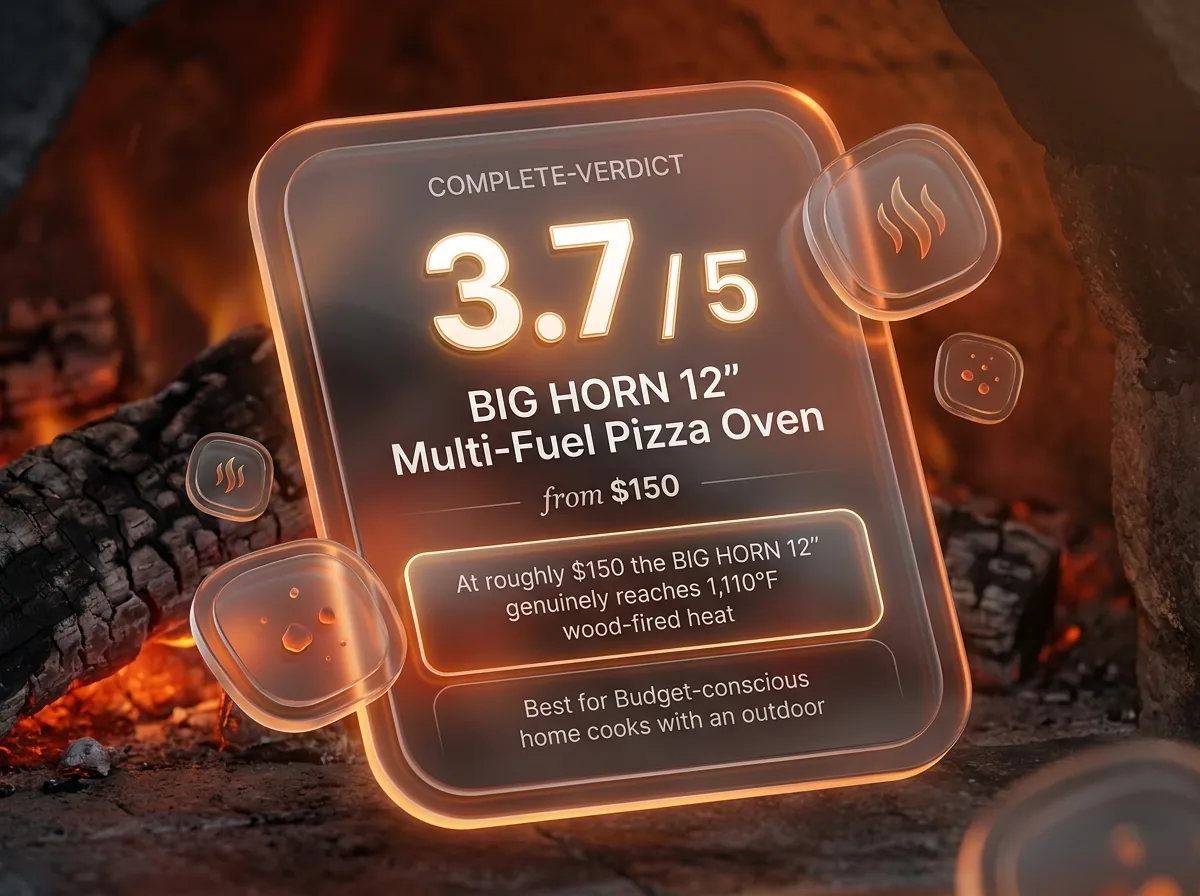
The BIG HORN 12" Multi-Fuel Pizza Oven Hits 1,110°F for $150, but the Gas and Electric Burners That Make It Livable Cost Extra
How it scores
What I liked
- Genuinely reaches ~1,110°F on wood/pellet fuel, owner-confirmed near 1,112°F
- Cooks a pizza in 60-90 seconds once the stone is up to heat
- Full stainless steel body feels sturdier than the price suggests
- Includes a 12x12-inch square stone and foldable legs, no tools needed to set up
- Assembles in under 10 minutes with just six screws
- Real upgrade path to gas or electric burners if you want steadier control later
- Delivers authentic wood-fired char that competes with ovens costing far more
What could be better
- Gas and electric burners are sold separately; only wood/pellet works out of the box
- Wood/pellet fire is genuinely hard to light and does not hold a steady temperature
- Door handle is riveted, spins when hot, and cannot be tightened
- The 12-inch opening makes turning a pizza with a standard peel awkward
- Real-world setup cost runs $200-$320 once pellets and a burner add-on are included
- 24-month warranty only applies to purchases made directly through bighornoutdoor.com
What Multi-Fuel Actually Means Before You Buy
The product title promises 3-in-1 wood, gas, and electric cooking, and that is technically true, but out of the box you get exactly one fuel: wood or hardwood pellets. The gas and electric burners are sold separately through Big Horn's own site. This single fact reshapes the whole purchase. At $120 to $150, you're buying a wood-fired oven with an upgrade path bolted on, not a ready-to-go three-in-one appliance.
Temperature is also fuel-dependent, and this trips up a lot of comparison shopping. On wood or pellet, owners running their own thermometers confirm the oven reaches close to 1,112°F, matching the advertised ceiling. Add the gas burner and you're capped around 350°C, roughly 662°F. The electric burner is rated up to 1,000°F by the brand. When you see a competing review citing 860°F, that reading likely falls within Big Horn's own gas or electric range, not proof of a different or lesser unit. All three numbers can be true at once; they just describe different fuels.
How Hot It Really Gets - and What the Number Doesn't Tell You
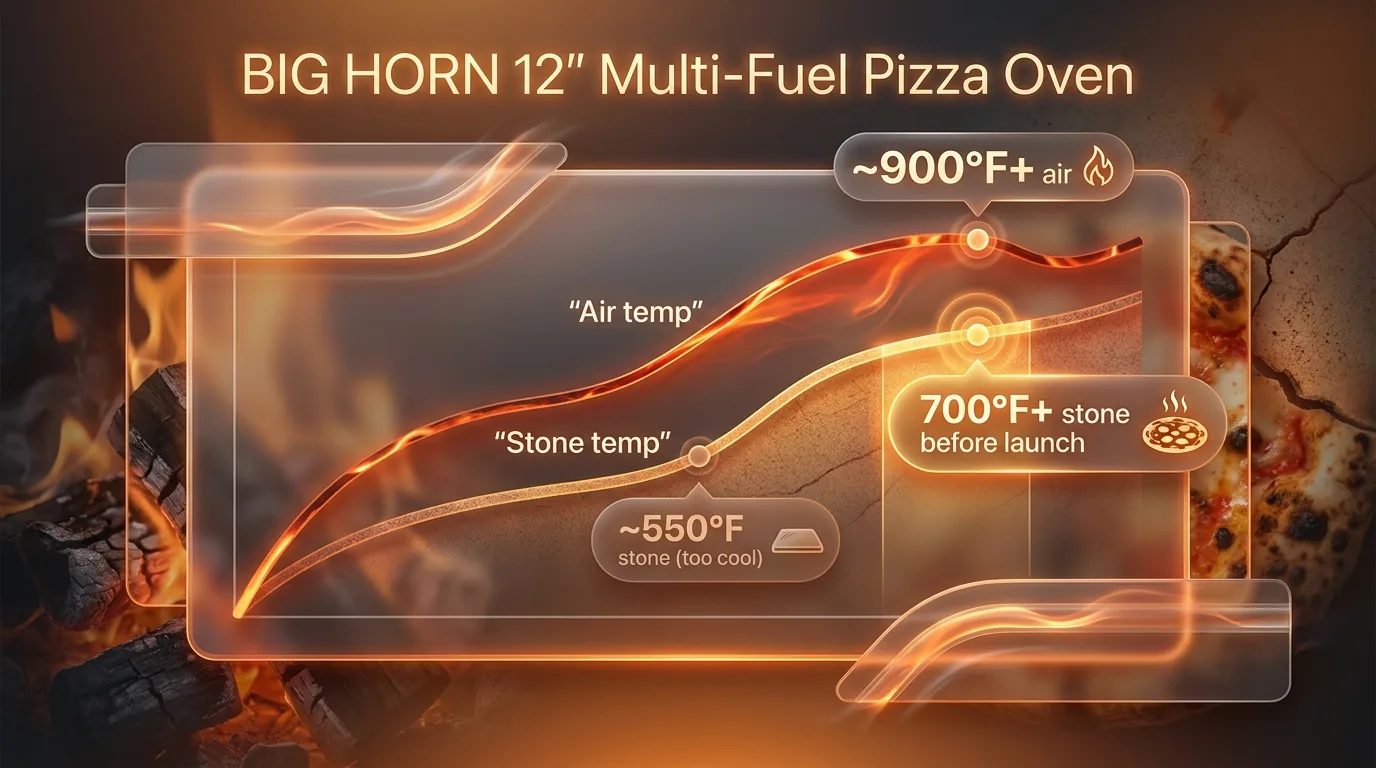
On wood or pellet fuel, this oven reaches genuinely serious heat, territory I trained on as a Neapolitan pizza chef. That's why a real 60 to 90 second bake is possible once the fire is established. But the number on the built-in gauge measures air, not stone, and that gap is the actual root cause of the burnt-top, raw-middle pizzas that show up in owner reports.
In my hands, I trust an infrared thermometer aimed at the center of the stone over the dial every time. Air temperature can already read 900°F while the stone underneath is still sitting at 550°F. Wait until the stone itself reads at least 700°F before you launch a pie; skip that step and you're setting yourself up to char the top before the crust ever sets underneath.
Wood and pellet fuel also will not hold a steady heat. It rises and falls with how much fuel is in the tray and how the air is moving through the chimney. That's a property of burning wood, not a defect unique to this oven. If steady, dial-it-in heat matters more to you than flavor, that's exactly what the separately sold gas burner is built to fix.
Lighting the Fire Without Losing Your Patience
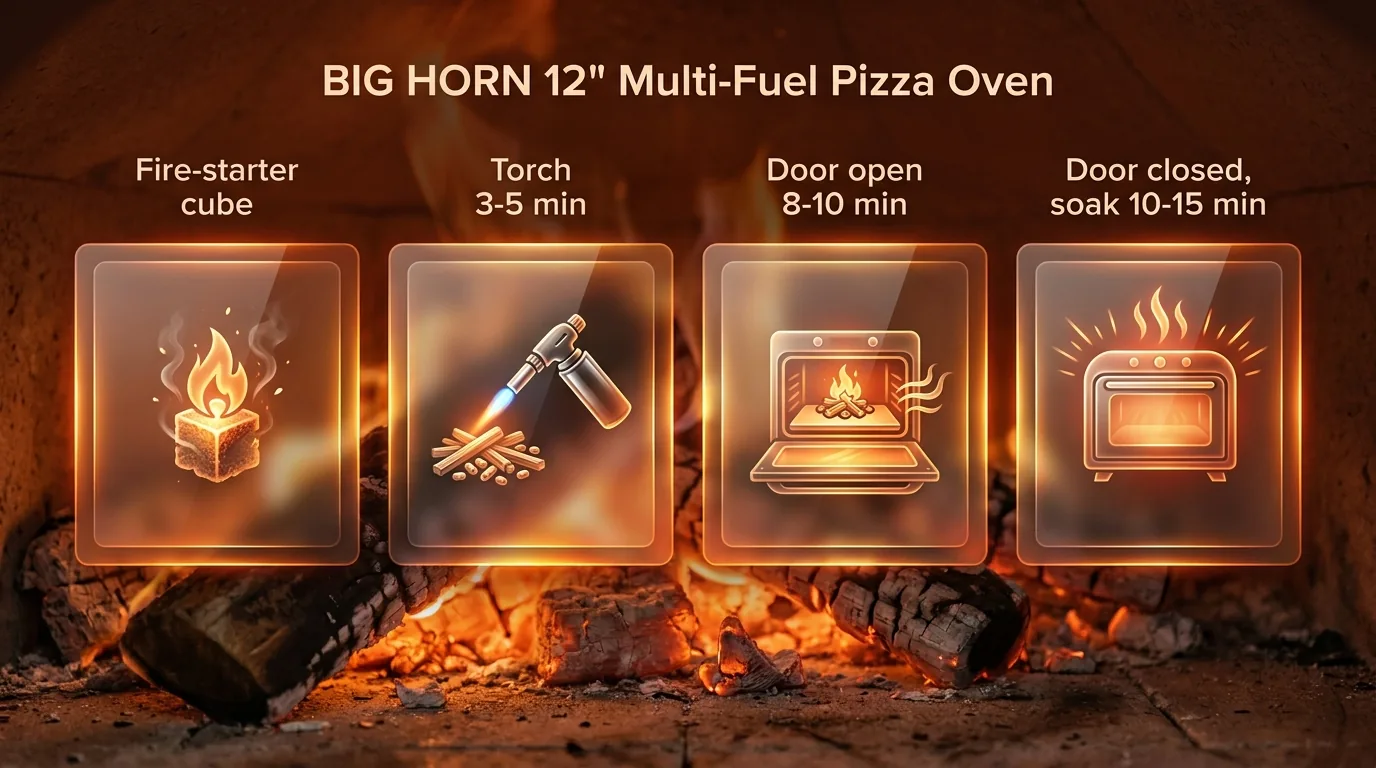
Getting the pellets lit is the single hardest part of owning this oven, and it's the complaint that shows up most consistently across owner reports. A lighter alone usually isn't enough. Fill the fuel tray about two-thirds full, set a paraffin fire-starter cube in the center of the bed, and hold a propane torch directly on it for three to five minutes, moving the flame to catch several pellet edges rather than chasing one spot.
Leave the door open for the first 8 to 10 minutes. Most instructions tell you to close it right away, which smothers the fire before it can establish. Once you see a steady glow and consistent smoke from the chimney, close the door and let the stone soak up heat for another 10 to 15 minutes before you check it with a thermometer. This two-stage approach is the difference between a fire that catches once and stays lit, and one you're re-lighting all afternoon.
Build Quality - A Solid Skin With One Real Weak Point
The stainless steel body feels sturdier than the price suggests, and the foldable legs make the roughly 25-pound oven genuinely easy to store and move. The included 12x12-inch square stone is a real value-add at this price, and assembly takes under 10 minutes with just six screws; no special tools required.
The weak point is the door. The handle is attached with rivets that can't be tightened, and once the oven is hot, it spins loosely in your hand. The door itself also doesn't seat flush once the metal expands under heat. This isn't a one-off defect; it's a pattern that shows up repeatedly even among otherwise satisfied owners. Wear an oven mitt on your door hand every session, and don't try to force it flush while it's still hot. Replacement parts availability isn't confirmed by the brand, so if the handle or stone ever needs replacing, contact Big Horn directly.
Getting a Great Pizza Out of It - Dough, Launch, and Turning
At 1,100°F, dough thickness is your main heat control. I recommend stretching 00-flour dough at 65 to 68% hydration out to about 10 inches, leaving turning room on the square stone, with a rim no thicker than 6 to 7mm. Anything thicker and the outside will char before the center finishes. Pre-made fresh dough from a grocery store pizzeria counter is a legitimate shortcut for a first-timer, not a cheat.
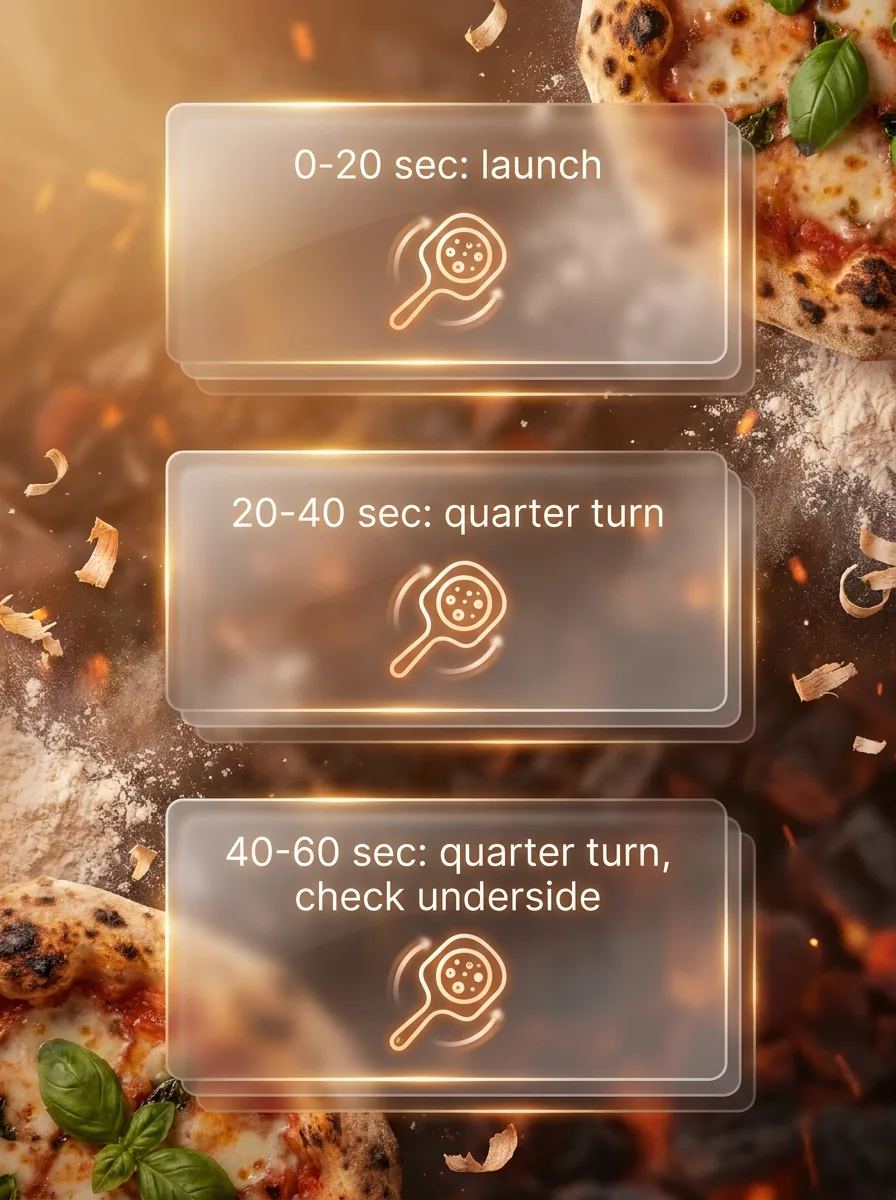
The 12-inch opening makes turning with a full-size peel clumsy and increases the odds of tearing a hot crust. I use a small 8 to 10-inch turning peel and rotate the pizza a quarter turn every 20 seconds rather than attempting a full flip. Check the underside at the one-minute mark and pull it or give it 10 more seconds.
If you're cooking for a group, expect the stone to drop 100 to 150°F after each pie from moisture and cold toppings. Add a small handful of pellets, close the door, wait three to four minutes, and recheck the stone temperature before launching the next one. This oven rewards active management between pizzas far more than it rewards a big batch cooked back to back.
Where Owners Keep Getting Burned - and How to Fix It
Burnt top, raw center: almost always the stone wasn't actually hot enough at launch, or the dough was too thick. Check stone temperature with an infrared thermometer and thin the dough before you blame the oven.
Pellets won't stay lit: usually damp or low-grade pellets, or the door closed too soon. Use dry hardwood pellets, a fire-starter cube, and leave the door open for the first several minutes.
Temperature won't hold steady: this is inherent to wood/pellet fuel, not a flaw specific to this unit. Accept the variability, or add the gas burner for consistent control.
Heavy smoke: wood combustion is smoky by nature, especially at ignition. Position the oven downwind from seating, and confirm any local outdoor-burn rules before you fire it up.
The Real Cost of Ownership Past the Sticker Price
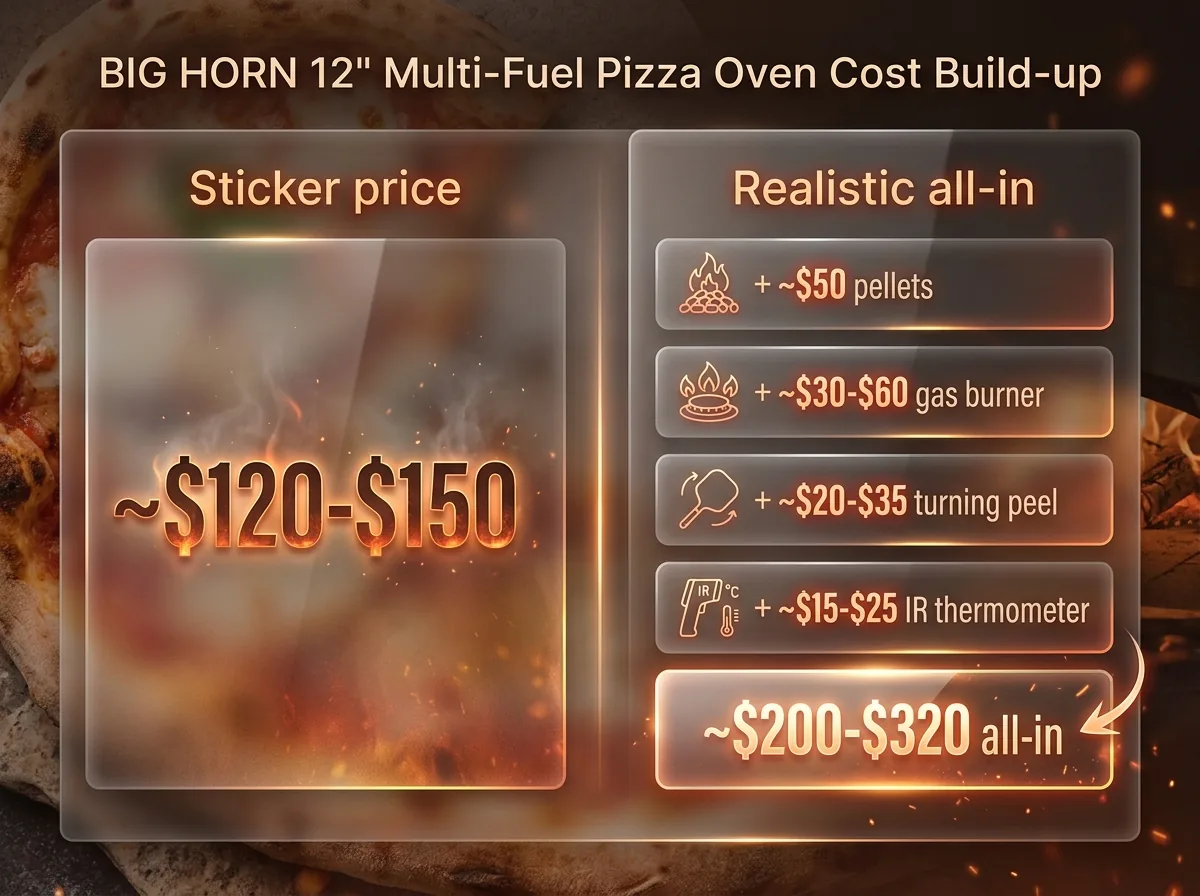
The $120 to $150 listing price is the entry fee, not the exit number. Budget roughly $50 in pellets just to dial in your technique during the first few sessions. A small turning peel runs $20-$35, and an infrared thermometer is $15-$25; both are close to essential given the small opening and the air-versus-stone temperature gap. Add the gas burner add-on, typically $30-$60, and a realistic all-in setup lands around $200-$320 for a comfortable experience, with a bare-minimum pellets-only setup closer to $170-$200.
That still compares well against the premium end of the category. An Ooni Karu 12 lists around $349 (often near $249 on sale) with a more refined multi-fuel build and steadier session-to-session consistency, but a lower ceiling near 950°F and, like the BIG HORN, a gas burner sold separately. If you're deciding between this tier and the gas-only crowd, our Bertello vs Ooni comparison lays out that trade-off in more detail, and the best Ooni pizza ovens guide is worth a look if a bigger budget is on the table. For a buyer whose hard ceiling is around $200 total, the BIG HORN is a genuine value few ovens can match.
Who It's For - and Who Should Buy Something Else
This is a fire-crafter's oven. It rewards a buyer who enjoys tending a fire, doesn't mind heavy smoke on a patio, and is willing to invest a few frustrating sessions before things click. For that person, at $150 plus a modest accessory spend, this is genuinely the most accessible route to authentic 1,100°F wood-fired pizza on the market.
It is not for anyone who wants to twist a knob and walk away. If that's you, a gas-only oven is the better fit, and you'll pay a premium for that convenience regardless of brand. One more thing worth checking before checkout: the 24-month warranty applies to direct purchases through bighornoutdoor.com. If you're buying through a third-party marketplace, confirm coverage with the brand first.
How it compares
| BIG HORN 12" Multi-Fuel Pizza Oven | Ooni Karu 12 | Ooni Koda 12 | |
|---|---|---|---|
| Price | ~$120-$150 | ~$349 (~$249 sale) | ~$399 (~$299 sale) |
| Fuel out of box | Wood/pellet only | Wood/charcoal | Gas/propane |
| Multi-fuel upgrade | Yes, burners sold separately | Yes, gas sold separately | No |
| Max temp | ~1,110°F (wood/pellet) | ~950°F | ~950°F |
| Cook time | 60-90 sec | ~60 sec | ~60 sec |
| Preheat time | 15-20 min | ~15 min | ~15 min |
| Stone included | 12x12-inch square | ~13-in round cordierite | 13-inch round |
| Weight | ~25 lb | ~26.5 lb | ~20.4 lb |
| Warranty | 24 mo, direct-purchase only | 5 years | 5 years |
| Learning curve | High (pellet fire management) | Moderate | Low |
Also worth considering
Ooni Ooni Karu 12
The established benchmark in the budget multi-fuel tier. At around $349 (often ~$249 on sale) it costs more than double the BIG HORN, but the build quality, larger cordierite stone, and five-year warranty are noticeably stronger. Its ceiling near 950°F is lower than the BIG HORN's wood/pellet peak, but more reproducible session to session. Like the BIG HORN, its gas burner is sold separately. The right pick for someone who wants to spend once and skip most of the troubleshooting.
Ooni Ooni Koda 12
The knob-and-go alternative for anyone who has priced out the BIG HORN plus its gas burner add-on and found the gap smaller than expected. Running entirely on propane, it reaches about 950°F with zero fire management and no lighting frustration. No multi-fuel flexibility, but also none of the pellet learning curve.
Solo Stove Solo Stove Pi Prime
A newer gas-only entrant around $299-$349 with solid build quality and a purpose-built propane design. Worth considering for anyone drawn to the BIG HORN mainly for its gas upgrade path; the Pi Prime delivers a purpose-built propane experience without the multi-fuel complexity or the pellet-lighting ritual.
Certifications & safety
- No UL/ETL/CSA listing found
- 24-mo warranty, direct purchase only
Frequently asked questions
How hot does the BIG HORN 12" pizza oven actually get?
On wood or hardwood pellet fuel it reaches up to roughly 1,110°F, with owners running their own thermometers confirming close to 1,112°F. On the separately sold gas burner it tops out near 350°C, about 662°F, and the electric burner add-on is rated up to 1,000°F by the brand.
Does the BIG HORN pizza oven come with a propane burner?
No. The gas burner is sold separately from the oven itself. Out of the box, the only fuel available is wood or hardwood pellets; the multi-fuel label describes the oven's compatible design, not bundled hardware.
Is the BIG HORN oven hard to light with wood pellets?
Yes, this is the most commonly reported friction point. A standard lighter usually isn't enough; a propane torch held on a fire-starter cube for three to five minutes, with the door left open, is the reliable method owners settle on.
Can you use the BIG HORN pizza oven indoors?
No. On wood or pellet fuel it produces heavy smoke and open flame, making it an outdoor-only appliance. Even the electric burner add-on is positioned by the brand as an outdoor product, so it's worth confirming any indoor-adjacent use directly with Big Horn first.
Does the BIG HORN oven come with a pizza stone?
Yes, a 12x12-inch square stone is included. It realistically fits a pizza around 10 to 11 inches once you leave room to turn it, and it needs to heat up gradually with the oven rather than being placed cold into a hot chamber.
How do you turn a pizza in the BIG HORN's small 12-inch opening?
I use a small 8 to 10-inch turning peel and rotate the pizza a quarter turn every 20 seconds instead of attempting a full flip through the narrow opening. Flouring the peel generously matters more here than on a wider oven, since a stuck pizza at 1,100°F becomes a problem fast.
BIG HORN vs Ooni Karu 12: which is better for the money?
For a strict budget, the BIG HORN plus its gas burner add-on delivers comparable wood-fired results at roughly half the all-in cost of the Ooni Karu 12, which lists around $349. The Karu 12 has a more refined multi-fuel build, a larger cordierite stone, and a five-year warranty, but it too sells its gas burner separately and costs materially more.
Is the BIG HORN pizza oven good for beginners?
It's accessible for a budget-first beginner, but it isn't plug-and-play. Anyone willing to accept a learning curve on lighting and temperature management tends to report strong results by the second or third pizza; anyone expecting instant, foolproof results will be frustrated in the first session.
Who makes the BIG HORN pizza oven?
It's made by BIG HORN Outdoors, whose direct store is bighornoutdoor.com. The ovens are sold mainly through third-party marketplaces like Amazon and Walmart. Note that the 24-month warranty applies only to purchases made directly through bighornoutdoor.com, so a marketplace buyer should confirm coverage with the brand.
How long does it take to cook a pizza in the BIG HORN pizza oven?
Once the stone is genuinely up to heat, a pizza cooks in about 60 to 90 seconds on wood or pellet fuel. The catch is preheat: budget 15 to 20 minutes and confirm the stone itself reads at least 700°F with an infrared thermometer before launching, since the built-in gauge measures air temperature, not the stone.
Are BIG HORN pizza ovens any good?
For the roughly $120 to $150 price, yes, with honest caveats. On wood or pellet it delivers genuine ~1,110°F wood-fired results that rival ovens costing far more, and owner sentiment runs strongly positive across roughly 2,600 reviews. But it demands fire-tending patience, the pellets are hard to light, the door handle is a known weak point, and a comfortable setup realistically runs $200 to $320 once you add pellets and the separately sold gas burner.
Is a multi-fuel pizza oven worth it?
It's worth it if you actually want the flavor of wood or the option to switch to gas convenience later, and you accept that on the BIG HORN the gas and electric burners cost extra. If you only ever plan to cook on gas, a dedicated gas oven like the Ooni Koda 12 is simpler and skips the pellet learning curve entirely.
BIG HORN 12" Multi-Fuel Pizza Oven
★ 3.7/5 · ~$150
Reader comments
Tried this oven, tool, or recipe? Share how it went — real experiences help other home pizza makers.