
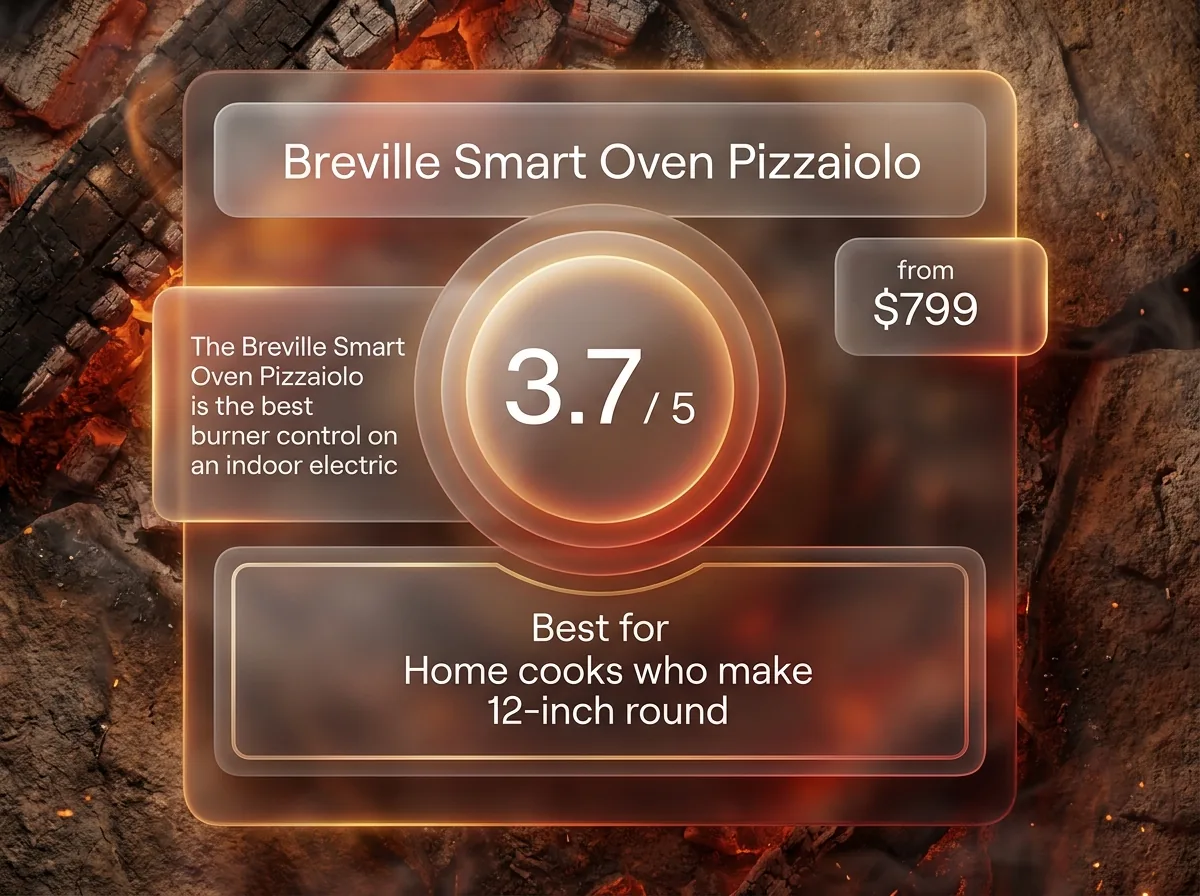
The Breville Smart Oven Pizzaiolo is the best burner control on an indoor electric oven - but at $999 it loses to the $899 Ooni Volt
How it scores
What I liked
- Best-in-class independent top (dome) and bottom (deck) heat control among indoor electric ovens
- "Crust only" mode delivers genuine Neapolitan leoparding without scorching the cheese
- Real ~2-minute Neapolitan bakes at 750F, far beyond a standard home oven's ~550F ceiling
- Runs on a standard 120V plug - no gas tank, no wood, no outdoor space required
- Five guided presets plus full manual override work for both beginners and dialed-in cooks
- Breville+ app adds 40+ guided recipes for onboarding
- Strong, well-documented used market makes it an exceptional value at $300-500
- Solid build quality that holds up over months of regular bakes
What could be better
- At full $999 MSRP, the roomier, better-insulated Ooni Volt at $899 is the more practical buy
- Smaller interior - both width and height - than the Volt limits larger pies and pan styles
- Can't fit a 10x14 Detroit pan; the low ceiling crowds pan pizza close to the top element
- Deep-pan cast-iron accessory is a separate $89.95 purchase in the US, not included in the box
- Cleaning is a genuine hassle - the stone can't be washed with water, and the interior is cramped
- Heavy, permanent countertop footprint - this isn't an appliance you store between uses
Is the Breville Pizzaiolo worth it - the price-dependent verdict
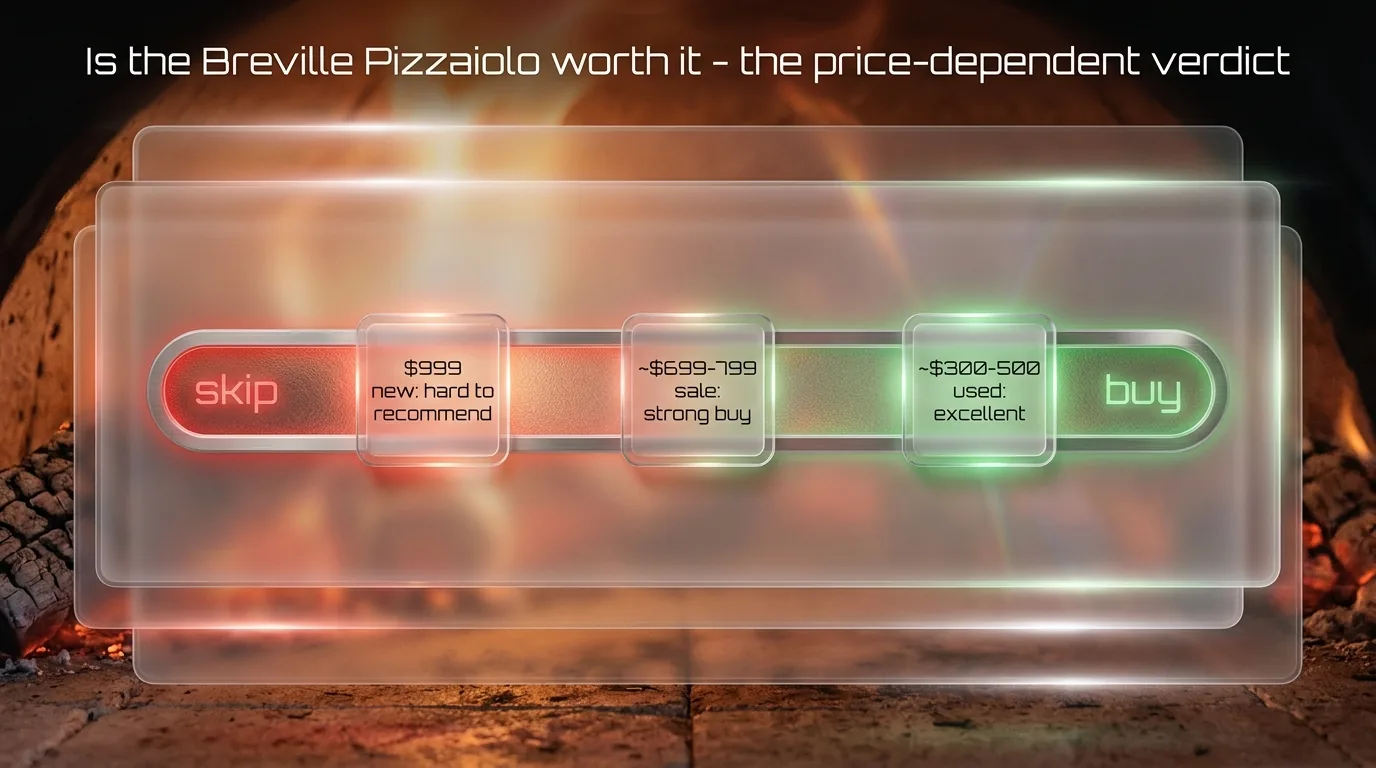
The honest answer depends entirely on what you pay, not on whether the oven performs. A reviewer who has put more than a dozen indoor and outdoor ovens through their paces put it plainly: the top burner is incredible, and the crust-only setting cooks Neapolitans well enough to leopard the crust without overcooking the cheese. But at $999, with the Ooni Volt sitting at $899, that same reviewer couldn't wholeheartedly recommend the Breville over the Volt.
Drop the price to $699-799, which is a common sale price, or find one used for $300-500, and the calculus flips hard in the Pizzaiolo's favor. This is a price-dependent verdict, not a binary yes or no, and any review that skips that nuance is doing you a disservice.
What's actually in the box - specs, size, and the accessory catch
The model is the BPZ820. It runs on a standard 120V outlet, draws 1800 watts, and tops out at 750F (about 400C). That's a genuine leap over a home oven's 550F ceiling and is the core reason it can leopard a crust at all.
The cooking deck is an 11.75-inch cordierite stone, and while the brand's product page lists capacity up to about 14 inches, 12 inches is the comfortable working size on that stone. Stretch dough much larger and you'll fight uneven heat at the edges.
You get five presets - Neapolitan, NY Style, Pan, Thin & Crispy, and Frozen - plus full manual override, and the Breville+ app adds more than 40 guided recipes. One catch worth flagging before you buy: the cast-iron deep pizza pan is a separate $89.95 accessory on the US product page, not something that ships in every box. Check what's actually included for your region before you assume it's bundled.
How Element iQ works - and why independent top and bottom heat matters
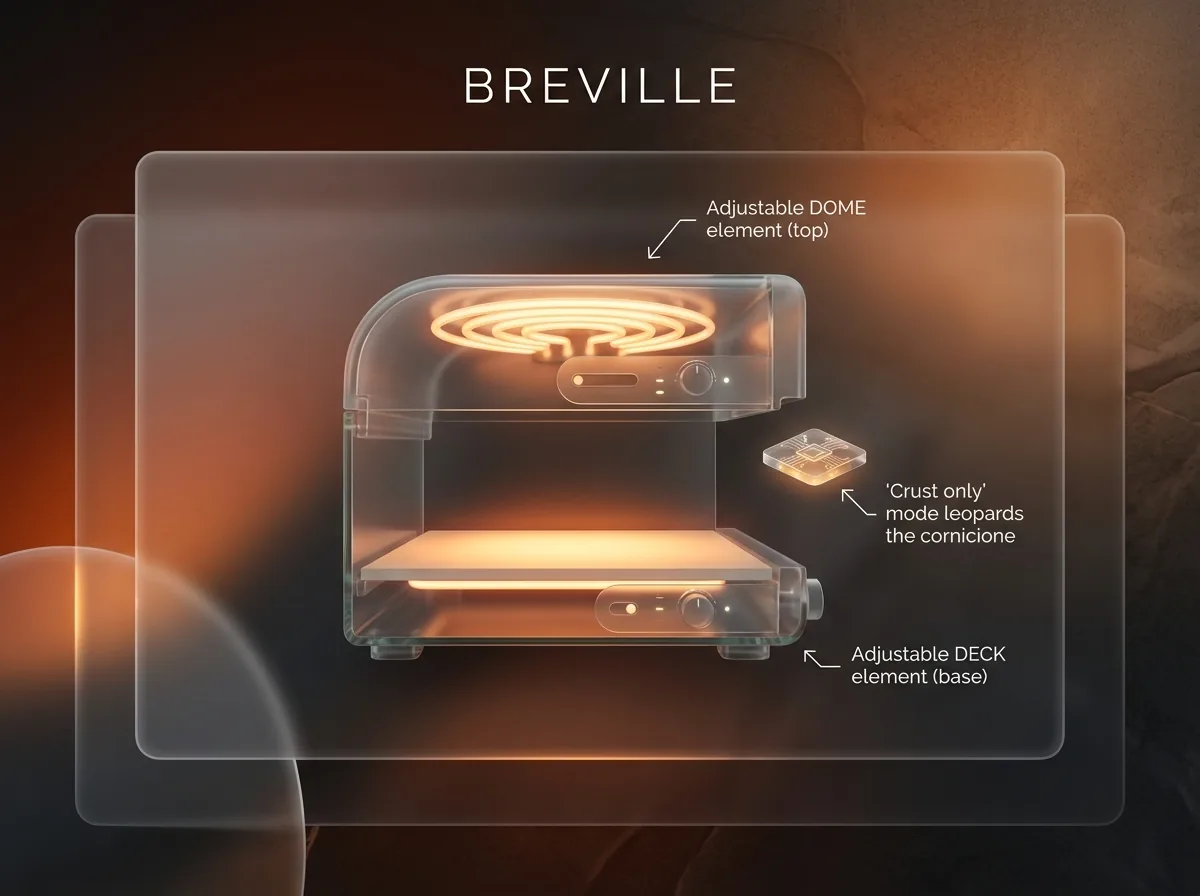
The Pizzaiolo's real advantage is a system Breville calls Element iQ: a deck (bottom) incoloy element that drives conductive crust crispness, and a separate dome (top) element that drives radiant char and cheese melt. A third convective mode circulates hot air to even things out. Together they approximate the heat envelope of a wood-fired hearth without an open flame.
The stone itself matters too. Cordierite is the same material used in commercial deck ovens because it stores and releases heat steadily, which is why the manual calls for a full preheat before the first pizza goes in. Skip that step and you get the classic complaint: burnt bottom, raw top.
The standout feature is "crust only" mode, which aims dome heat at the outer ring of the pizza while easing off the center. That's the mechanical trick behind genuine leoparding without blown-out cheese, and it's confirmed by both owner accounts and independent reviewer testing. As a chef, I'd put it this way: a wood-fired pizzaiolo manages that same balance by rotating the pie toward or away from the flame. This oven automates that judgment through a dial instead of a peel.
Setting it up - unboxing, the break-in burn, and your first three pizzas
Unboxing takes 30 to 45 minutes because the unit ships carefully packed, and it's heavy. Pick a permanent countertop spot before you unpack it; this isn't an oven you tuck away between pizza nights.
Before any dough goes in, the manual calls for a roughly 20-minute break-in burn at 750F. That step burns off manufacturing residue and seasons the stone, the same logic as seasoning a cast-iron pan. Give it 25-30 minutes if you can; a longer soak means more even heat across the whole deck.
Expect your first pizza to be a diagnostic bake, not a showcase. Professional pizzaioli call this the sacrifice pizza. One early reviewer got an under-baked top and burnt bottom on pizza one, using the default Wood-fired preset - that's a calibration issue, not a broken oven. Switch to manual mode, trim the deck temperature, confirm the preheat ran its full course, and use the crust-only mode in the final seconds if the top needs help. Most owners land on dialed-in settings by pizza two or three, which is the one to invite guests for.
Does it make real Neapolitan pizza - the honest read on leoparding and bake time
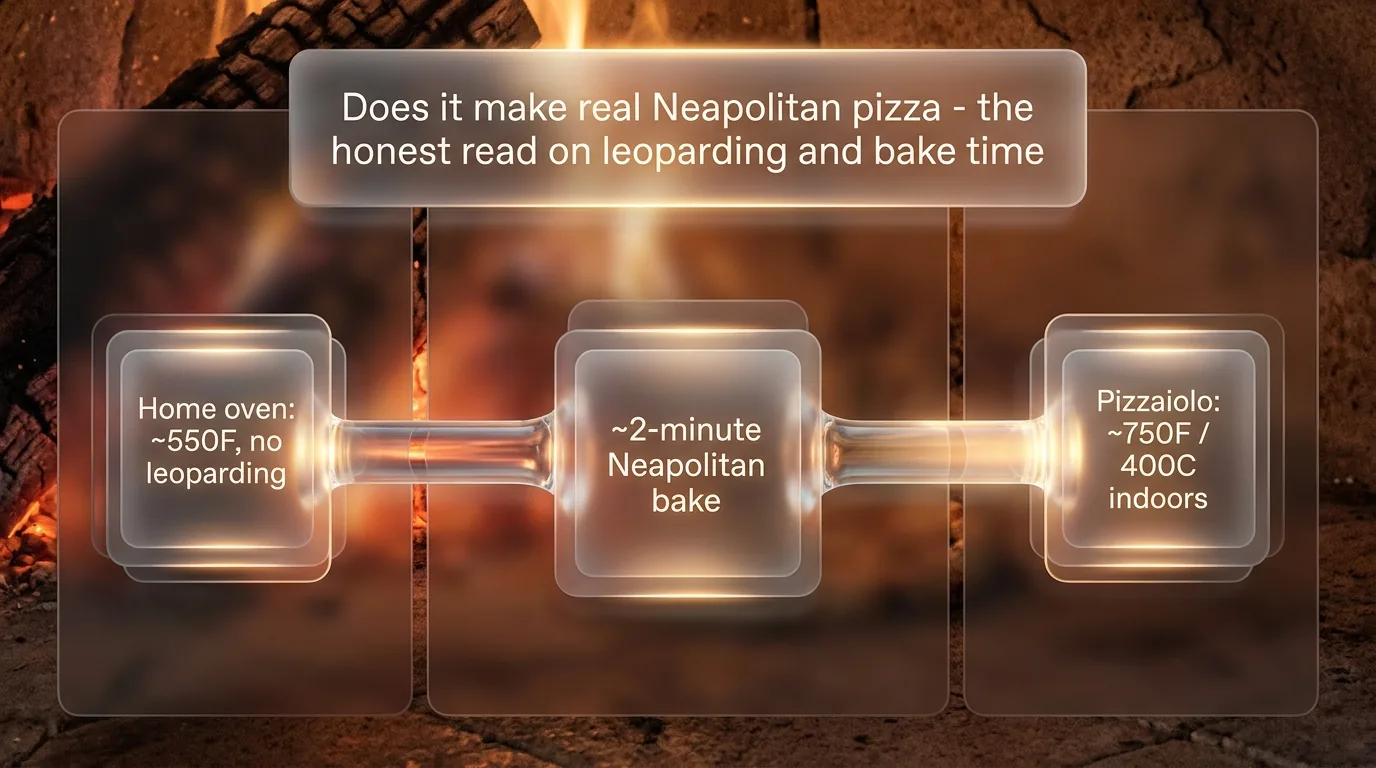
True Neapolitan pizza calls for a blistered cornicione, a tender interior crumb, a lightly charred underside, and a cook time of roughly 60-90 seconds in a traditional 900F wood oven. At 750F electric, the Pizzaiolo runs about 150F short of that standard, but it makes up ground with the dome element's direct radiant heat - a different heat profile, not necessarily a worse one for a home kitchen.
The evidence backs that up. The 15-plus-oven reviewer confirmed genuine leoparding and cheese that isn't overcooked using crust-only mode. A televised gadget test using a 48-hour fermented dough found good leopard spotting and structure, with one mid-bake rotation recommended for even char. America's Test Kitchen's head-to-head concluded that both the Pizzaiolo and the Ooni Volt produce restaurant-quality pizza, and that the Volt's 100F temperature edge doesn't meaningfully change the outcome. Their cook times ran 4-5 minutes at moderate settings; the 2-minute figure is what you get at max heat with a thin, properly stretched dough.
My chef take: for a 63-68% hydration dough on 00 flour, this design is legitimately capable of restaurant-grade results. It won't pass for an AVPN-certified Neapolitan pizzeria oven - no home appliance can - but it's the closest thing to that result on a standard US plug. Cold-ferment your dough 48-72 hours, stretch it to 10-11 inches rather than the full 14-inch capacity, and use Type 00 flour rather than bread flour; one early tester confirmed bread flour bakes up noticeably stiffer under this much radiant heat.
Getting the most out of it - dough, settings, and chef techniques
The presets are solid starting points, but manual mode is where real control lives, letting you dial deck and dome heat independently. For Neapolitan, push both to max and add crust-only for the final 20 seconds. For NY style, run the deck high and the dome medium-high for a 5-7 minute bake. Pan pizza is technically supported, but the low ceiling crowds the top element - this isn't the oven's strong suit, and the Volt handles it better.
Launch with a well-floured metal peel; semolina works better than fine flour here because it acts like ball bearings under the dough during that short launch window. One reviewer found the included peel wasn't ideal for launching and caused a pizza to slide off, so budget for a decent aftermarket peel. Rotate the pizza once at the halfway point - stone decks always carry slight hot-spot variation, and a rotation corrects for it.
If you're baking several pies back to back, let the deck rest three to four minutes between pizzas, or dial the deck setting down 5-10% for pizza two and three. Professional pizzerias do the same thing during a busy service to keep the base from scorching before the top finishes.
Ventilation and indoor smoke - the honest answer
This is an indoor oven, and it's designed to be used indoors, but indoor doesn't mean smoke-free. At 750F, dripping oil, toppings, or excess flour on the stone will smoke - that's basic physics, not a defect. Owners consistently flag ventilation as important, and one specifically runs the unit under an externally venting range hood and considers that setup necessary rather than optional.
A hood that vents outside is the strong recommendation. A recirculating hood helps but won't fully clear fine smoke particles. Without any hood, crack a window and point a fan on exhaust. Keep toppings restrained, don't over-oil the dough, and wipe excess semolina off the peel before it hits the deck - those three habits cut most smoke triggers. One reviewer noted the oven can also run outdoors on a heavy-gauge extension cord, which sidesteps the smoke question entirely, though it's still an indoor appliance used occasionally outside, not a weatherproofed outdoor unit.
Cleaning and maintenance - the complaint owners keep raising
Cleaning is a legitimate, repeated complaint, not an edge case. Set your expectations before you buy. The cordierite stone can't be washed with water or soap - moisture risks thermal shock and cracking - and the confined interior collects grease and char that's harder to reach than in a standard oven.
The workable routine: let the unit cool fully, brush the stone dry (burned-on residue mostly cooks off during the next high-heat bake, which is actually the correct approach), wipe the interior walls with a barely damp cloth once cool, and wipe the exterior like any stainless appliance. If you buy the cast-iron deep pan, treat it like any cast iron - no soap, dry immediately, re-oil after washing. Do a light stone brush every two to three bakes and a full interior wipe every five or six sessions, and don't expect the inside to look showroom-clean; it doesn't need to.
True cost of ownership - new, on sale, or used
MSRP is $999, but the base price has settled closer to $799 with frequent sales down to about $699. A well-documented used market puts nearly-new units at $300-500 on marketplace listings, and one buyer described paying $300 for a barely-used unit as a fantastic deal. Add the $89.95 deep pan and a decent aftermarket peel if you want both, and your all-in cost ranges from roughly $850-1,200 new down to $430-650 used.
Running costs are trivial: at 1800 watts and a typical 45-minute session covering preheat plus three or four pizzas, you're looking at about $0.06-0.07 in electricity per pizza. Compared to $18-24 for delivery, the math works fast - about 47 pizzas to break even at the $699 sale price, and closer to 20 pizzas if you bought used at $300. One owner who tracked roughly 35 pizzas over several months said the oven had effectively paid for itself.
If you're shopping used, ask for photos of the stone before you buy. A cracked or chipped cordierite deck is a disqualifier, and replacement availability through Breville service isn't guaranteed.
Breville Pizzaiolo vs the Ooni Volt and Koda - who actually wins
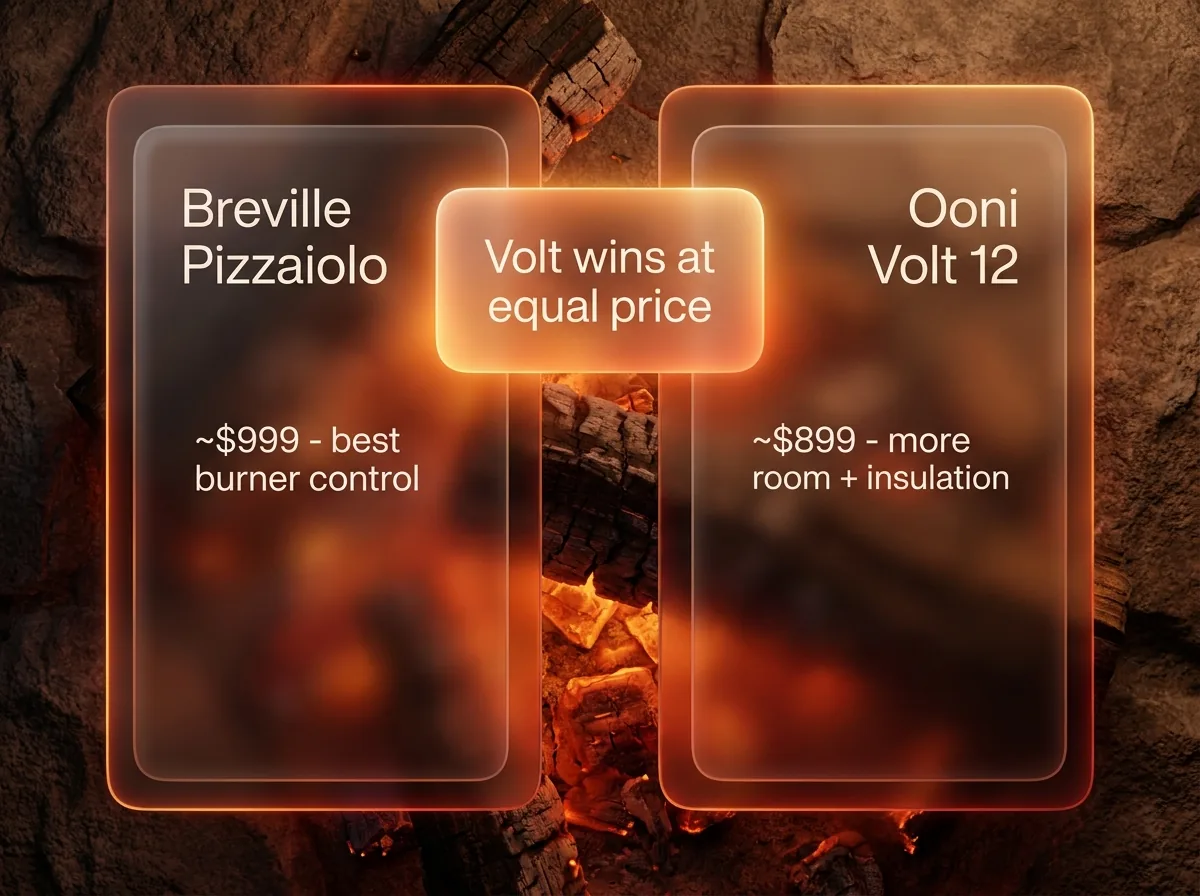
The Ooni Volt 12 is the direct rival worth weighing seriously, and it's covered in depth in our full breakdown of Ooni ovens. It reaches about 850F, holds heat better thanks to thicker insulation, and fits a 10x14 Detroit pan the Pizzaiolo simply can't accommodate. What it doesn't have is the Pizzaiolo's independent top-and-bottom burner control or the crust-only mode. The reviewer who tested both put it succinctly: the ideal oven would be the Volt's interior with the Breville's adjustable top burner.
At equal price, the Volt is the more practical daily driver. At a $699-799 Pizzaiolo against an $899 Volt, the comparison tightens considerably in the Breville's favor.
The Ooni Koda 16 is a different category entirely - outdoor propane only, reaching about 950F and fitting a full 16-inch pizza for around $599. It's the better choice if you have outdoor space and want the highest peak heat for the least money, but it's the wrong tool for an indoor-first buyer, full stop.
Who it's for - and who should skip it
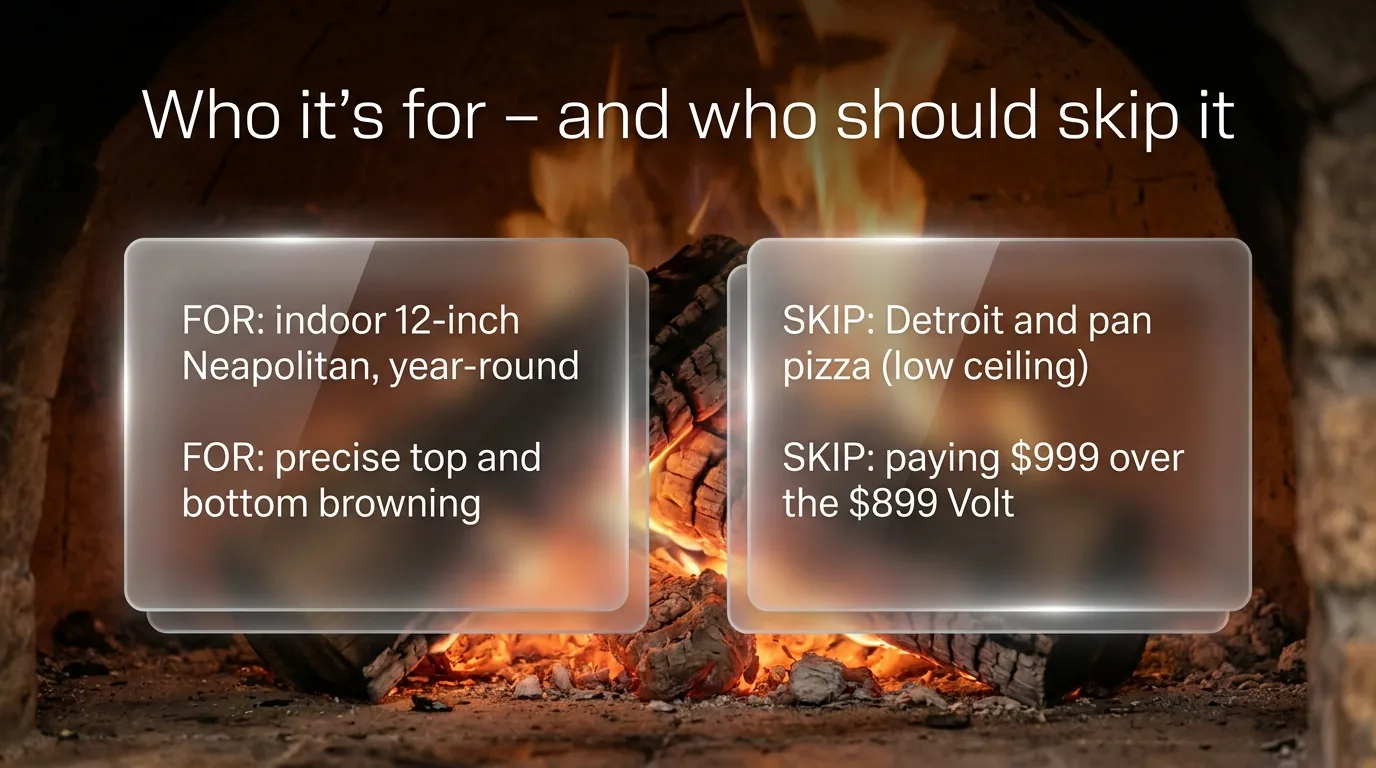
Buy it if you cook 12-inch round Neapolitan or NY-style pizza regularly, don't have reliable outdoor space, and can commit a permanent stretch of countertop to it - ideally at a discounted or used price rather than full MSRP. The burner-level control here has no real match among indoor electric ovens, and that's worth paying for once the price is right.
Skip it if Detroit, grandma-style, or deep-dish pan pizza is your main style - the low ceiling and narrower interior work against you there. Skip it too if you're only willing to pay $999, since the Ooni Volt is both cheaper and roomier at that price point, or if a difficult cleaning routine is a genuine dealbreaker rather than a minor annoyance. For readers weighing electric options more broadly, our guide to electric pizza ovens covers where this one fits among the wider field.
How it compares
| Breville Smart Oven Pizzaiolo | Ooni Volt 12 | Ooni Koda 16 | |
|---|---|---|---|
| Max temperature | 750F / ~400C | ~850F / ~450C | ~950F / ~510C |
| Neapolitan cook time | ~2 minutes | ~60-90 seconds | ~60-90 seconds |
| Indoor use | Yes, standard 120V plug | Yes, standard 120V plug | No, outdoor only |
| Power source | Electric, 1800W | Electric | Propane gas |
| Interior size | Smaller, lower ceiling | Roomier, fits Detroit pan | Large, 16in pizzas |
| Burner control | Independent top and bottom elements, best in class | Three simple dials | Manual flame management |
| Pan pizza capability | Limited, low ceiling | Fits a 10x14 Detroit pan | Yes, large stone |
| Price | $999 MSRP, often $699-799 | ~$899 | ~$599 |
| Best for | Precision indoor Neapolitan/NY control | Indoor all-styles including pan pizza | Outdoor high heat, large pizzas |
Also worth considering
Ooni Volt 12
The Pizzaiolo's most direct rival, and often the more practical daily driver. It runs hotter, holds heat better thanks to thicker insulation, and fits a 10x14 Detroit pan the Breville can't touch. It gives up the Pizzaiolo's independent top-and-bottom burner control and crust-only mode, which is the one thing the Breville still does better than anyone. At equal price the Volt wins on livability; at a Pizzaiolo discount, the gap closes fast.
Ooni Koda 16
A completely different category - outdoor propane only, reaching around 950F for roughly $599. It's the right call if you have a yard and want the highest peak heat for less money, fitting a full 16-inch pizza in the process. But it demands outdoor space, a propane tank, and weather tolerance, so it's the wrong tool for the indoor, year-round use case the Pizzaiolo is built around.
Generic Home Oven + Baking Steel
The budget answer skeptics reach for, and a fair one at $80-150 for a quality steel. It produces excellent NY-style pizza and a reasonable approximation of Neapolitan in a standard 550F oven. What it can't do is leopard a cornicione or hit a 2-minute bake window - that ceiling is real, and it's exactly the gap the Pizzaiolo is built to close for anyone baking more than occasionally.
Certifications & safety
- UL/ETL listing not confirmed
Frequently asked questions
Is the Breville Pizzaiolo worth the price?
At $999 it's a tough call against the $899 Ooni Volt, which offers more interior room. At $699-799 on sale or $300-500 used, it's an excellent buy for indoor Neapolitan and NY-style pizza.
How hot does the Breville Pizzaiolo get?
It reaches a maximum of 750F, or about 400C, which is well beyond any standard home oven's roughly 550F ceiling and enough for genuine 2-minute Neapolitan-style bakes.
Can the Breville Pizzaiolo make real Neapolitan pizza?
It makes an excellent Neapolitan-style pizza with confirmed leoparding via the crust-only mode. It isn't AVPN-certified Neapolitan, which is a pizzeria-level standard, but it's the closest result achievable on a standard 120V plug.
What size pizza fits in the Breville Pizzaiolo?
The listed capacity is up to about 14 inches, but the cordierite stone deck itself is 11.75 inches, so a well-stretched 12-inch pizza is the comfortable, practical size.
Is the Breville Pizzaiolo hard to clean?
Yes, cleaning is consistently flagged as a genuine hassle. The stone can't be washed with water or soap due to thermal shock risk, and the confined interior takes more effort than a standard oven.
Does the Breville Pizzaiolo need ventilation or a range hood?
Yes. At 750F, toppings and residue produce real smoke, and owners consistently treat an externally venting range hood as necessary rather than optional.
Breville Pizzaiolo vs Ooni Volt - which is better?
The Volt has a roomier interior, better insulation, and fits a Detroit pan the Breville can't. The Pizzaiolo counters with superior independent top-and-bottom burner control and a crust-only mode the Volt lacks; at equal price, the Volt is the more practical all-around pick.
Is it worth buying a used Breville Pizzaiolo?
Yes - a well-maintained used unit at $300-500 is one of the strongest value plays in indoor electric pizza ovens, provided you check the cordierite stone for cracks before buying.
Breville Smart Oven Pizzaiolo
★ 3.7/5 · ~$799-999 new. Model BPZ820
Reader comments
Tried this oven, tool, or recipe? Share how it went — real experiences help other home pizza makers.