
The CROSSON Double Deck 16" Electric Pizza Oven Delivers Real Commercial Batch Baking at $569 - Until the Four-Month Mark Tests Its Switches and Its Certification Claims
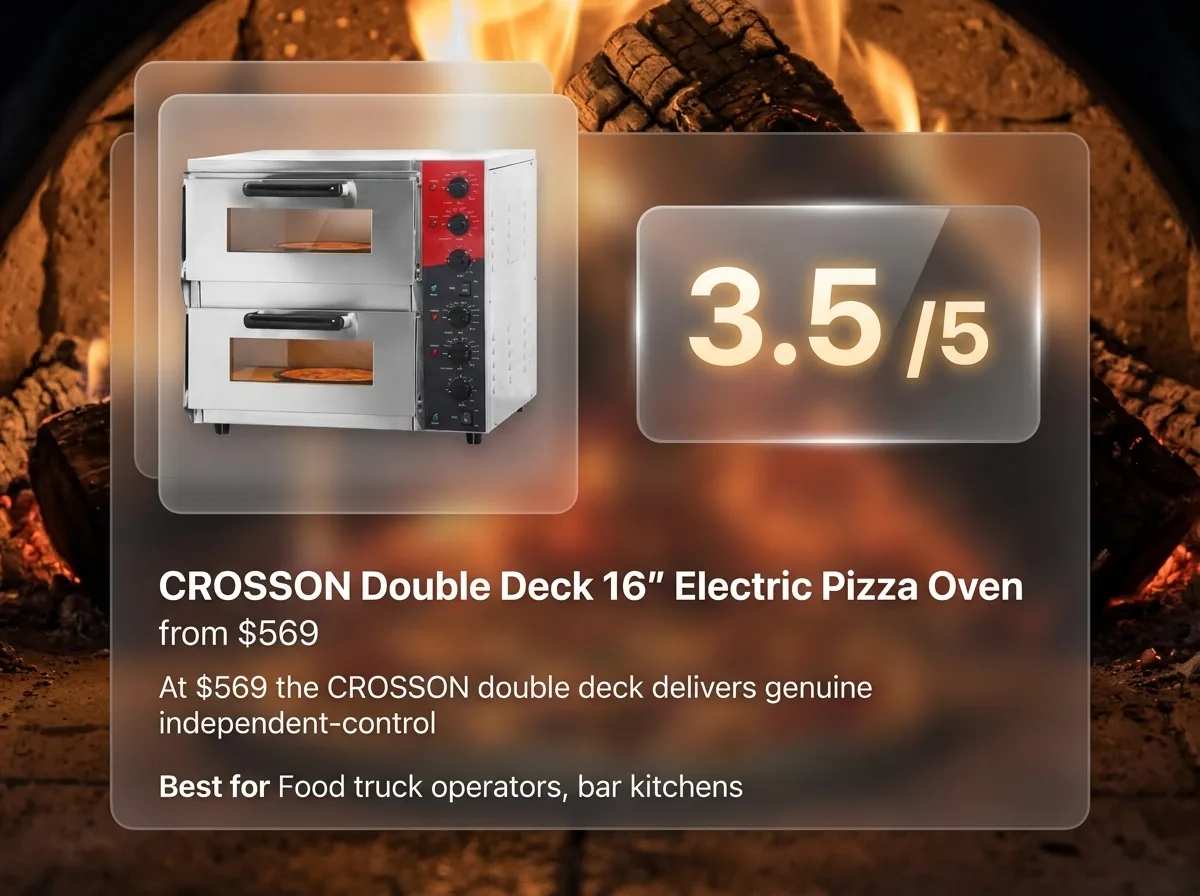
How it scores
What I liked
- Two fully independent decks, each with its own top-heat dial, bottom-heat dial, and 60-minute timer
- Genuine stone-baked crust texture, not a metal-tray compromise
- Batch capacity built for 10-12 pizzas in a single service run
- Rated to a 660F ceiling on both dials, on both decks
- Stainless steel body wipes clean and holds up cosmetically under commercial use
- Seller ships free replacement parts, including stones and upgraded steel legs
- Delivers double-deck batch output that otherwise requires a far more expensive commercial oven
What could be better
- Owners report power switches, thermostats, and cables melting or failing around the four-month mark
- The certification claim is disputed - one commercial buyer found only a CE sticker, no NSF, UL, or ETL mark on the actual unit
- Original plastic legs melted under sustained heat before the seller switched to steel
- Requires a dedicated grounded outlet and a large countertop footprint
- Heat can run below the 660F claim and cook times stretch under heavy, sustained turnover
The Promise vs. The Four-Month Reality
Picture two red-knobbed decks glowing behind their viewing windows, both mechanical timers ticking, a 16-inch pie baking on each stone during a Friday rush. That's the promise: commercial double-deck output for $569, a fraction of what a real deck oven costs. Then, months later, a subset of owners report a melted power switch and a set of plastic legs sagging under the heat.
That tension is the honest frame for this whole review. The CROSSON is not simply a good oven with a few complaints bolted on. It's an oven that genuinely delivers commercial-clone batch performance and then, for a meaningful slice of buyers, hits a documented reliability wall. Its buyer base is almost entirely small commercial operators - food trucks, concession stands, bars - not casual home cooks, and their standards and pain points are professional ones.
Is it any good? For batch pizza service on a tight startup budget, yes - genuinely. The real risk isn't the pizza it produces. It's whether the switch, the thermostat, and the legs survive long enough to keep producing it.
What You Actually Get for $569
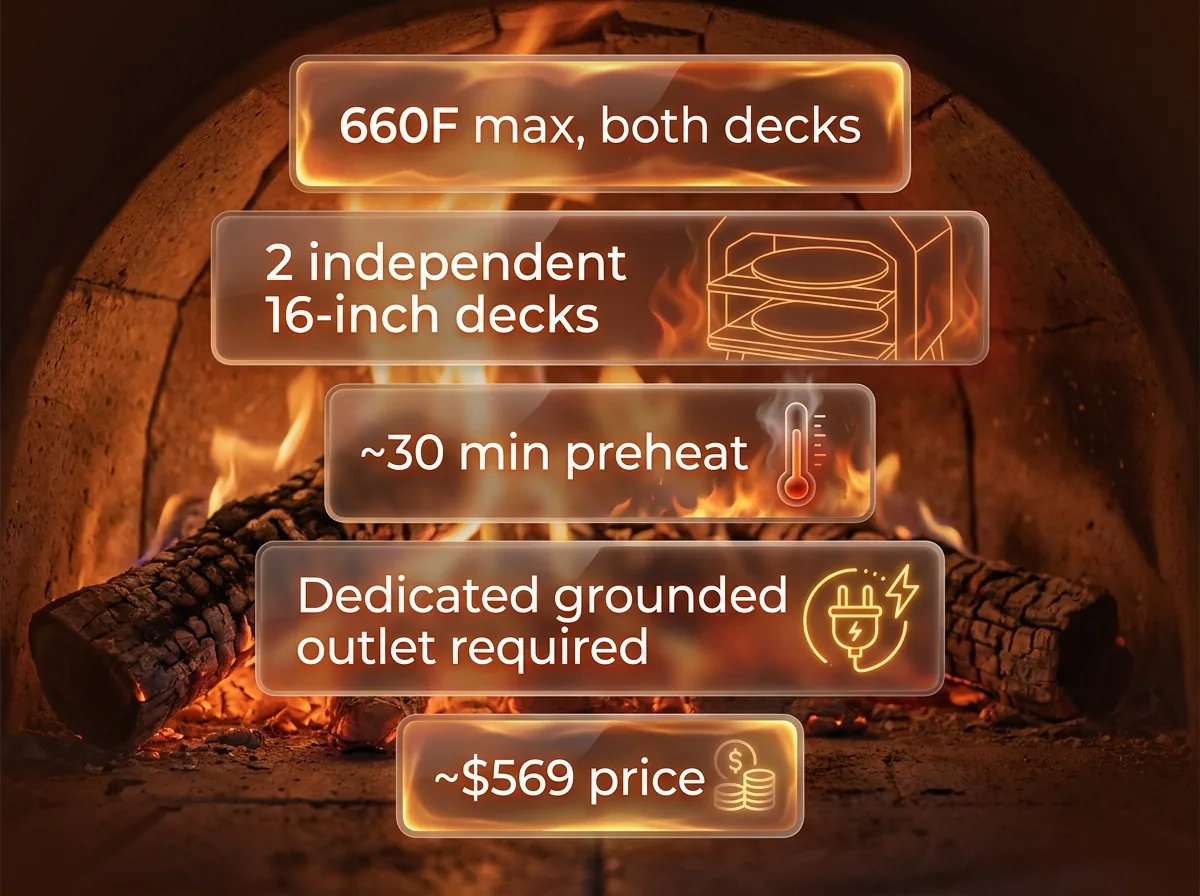
Two independent 16-inch decks are the headline. Each has its own top-heat dial, its own bottom-heat dial, its own 60-minute mechanical timer, a stone, a viewing window, and an interior light. Both dials on both decks are rated to a 660F ceiling. The body is stainless steel, and the whole unit measures 22.4 inches deep, 23 inches wide, and 20.8 inches tall - a real countertop commitment, not a compact appliance.
What isn't published matters too: exact wattage and amperage, stone thickness, and unit weight aren't listed, so I won't invent numbers here. What CROSSON does say clearly is that it draws high power and needs a dedicated grounded outlet - plan for that before it arrives, not after.
Why the Double-Deck Design Actually Matters to a Pizza Chef
Independent top and bottom heat controls on each deck aren't a convenience feature - they're the difference between a batch pizza tool and a countertop toy. Bottom heat drives the stone, and the stone drives the crust. Top heat drives the melt and the char on cheese and toppings. Force both off one dial, which most budget ovens do, and you're always compromising: what blisters the crust risks scorching the top.
Yes, you can cook just one pizza on a single deck - but it's an inefficient use of a roughly 30-minute preheat that costs the same in time and electricity whether you bake one pie or twelve. This oven pays for itself across a full service run, not a single pizza. And yes, it genuinely can cook two 16-inch pizzas at once; that independence is the entire point of buying it over a single-deck unit.
A stone retains and radiates heat differently than a metal tray - it pulls moisture off the dough bottom and gives you real bottom char, the texture that actually defines a properly baked crust. That's heat transfer physics working for you, not marketing.
Setup, Power, and the Batch Workflow That Gets Consistent Bakes
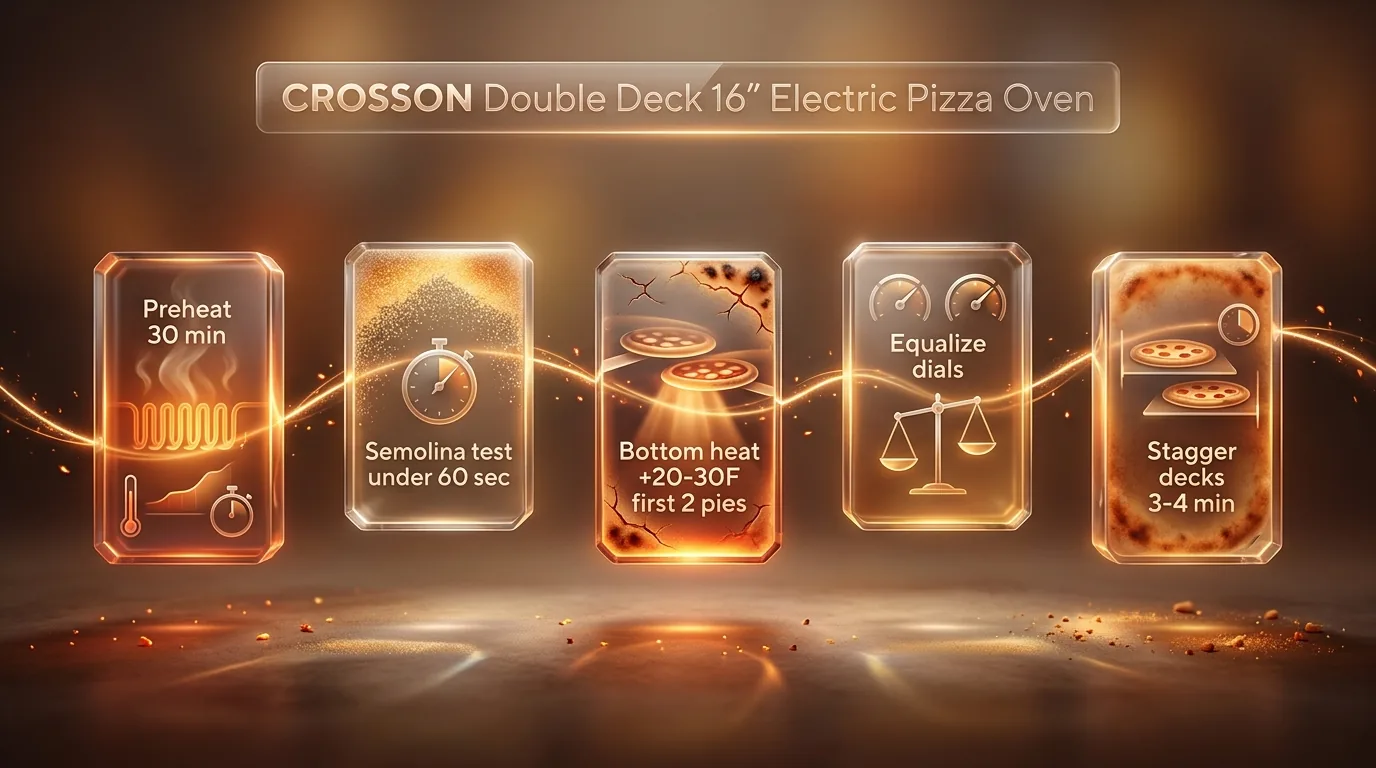
Give both decks the full 30-minute preheat before the first pie goes in - that's the biggest driver of consistent results and the step most first-timers skip. A useful field check: drop a pinch of semolina on the stone; if it browns in under 60 seconds, you're ready. Still pale at 90 seconds, give it another 10 minutes.
On the first two pies, run the bottom dial 20-30 degrees hotter than the top - the stone gives up some stored heat on the first load, and this compensates before it re-saturates. Equalize the dials after pie two or three. During a rush, stagger deck one and deck two by three to four minutes rather than loading both at once; it keeps you from managing two finished pizzas simultaneously.
Identify the breaker for your outlet before you ever plug in, and confirm nothing else high-draw shares it. A tripped breaker mid-service is more than annoying - it's a stress event for the same electrical components that are already the oven's most likely failure point.
How Hot It Really Runs Under Load
Both dials on both decks are rated to 660F, and under a full preheat with moderate turnover, that ceiling is achievable. Under sustained heavy turnover - a real food-truck rush - some owners report the oven running cooler than claimed, with cook times stretching toward 15 minutes instead of the 6-8 minutes you get on a properly heat-soaked stone.
That gap is mostly recovery time, not a broken thermostat. A cold dough disc pulls heat out of the stone surface, and the stone needs a moment to pull it back from the element before the next load performs identically. High-volume runs that skip that recovery window will see the temperature drift owners describe. Burnt edges paired with a raw center is usually a dial-balance issue, not a design defect - the same learning curve you'd face on any real deck oven, because the stone tells you everything if you're paying attention.
ETL vs NSF vs CE - the Certification Claim That Matters Most
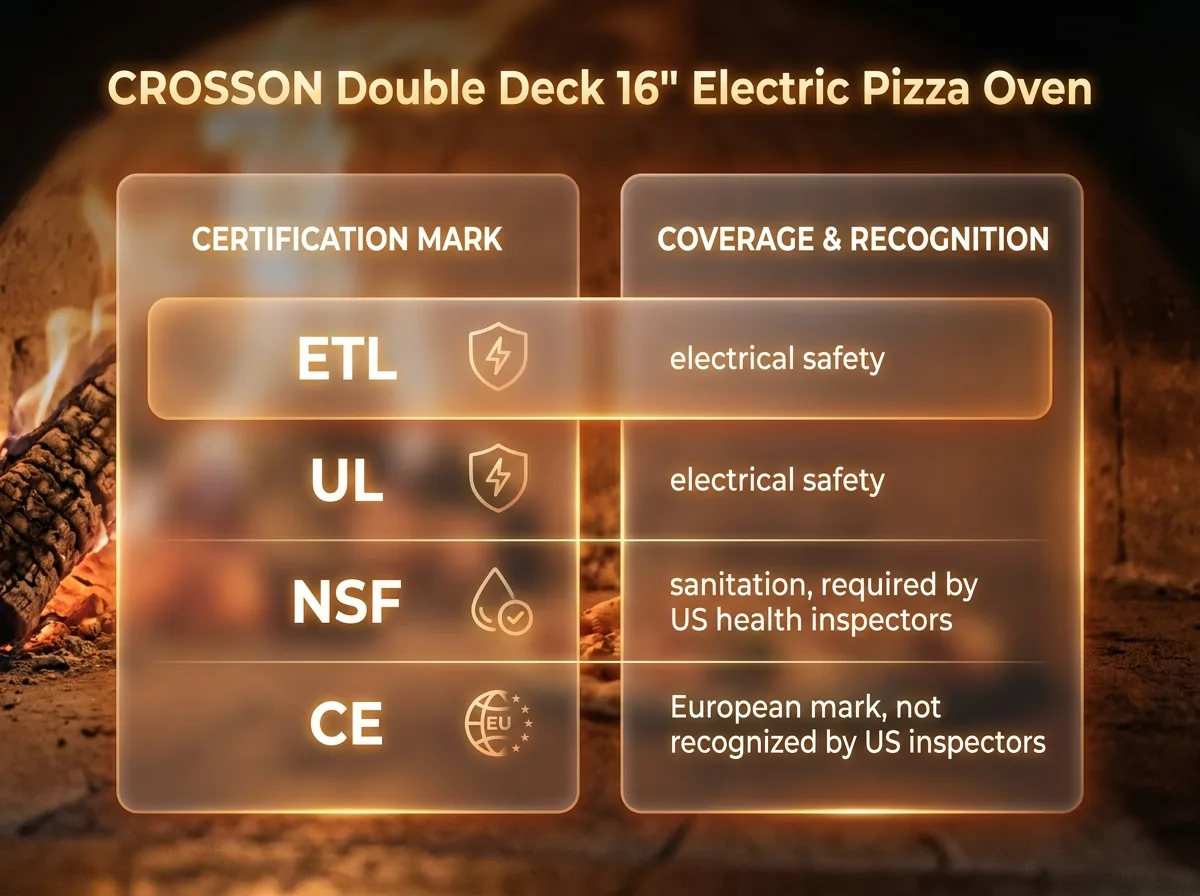
The CROSSON listing is titled "ETL listed" and references "UL approved key components," but this claim is disputed, not settled. At least one commercial buyer reported that the actual unit carried only a CE mark - a European conformity stamp - with no NSF, UL, or ETL sticker anywhere on the appliance.
This distinction is not pedantic. ETL and UL certify electrical safety. NSF certifies sanitation and food-contact materials, and NSF is what US health inspectors actually require for a permitted commercial kitchen. A CE mark satisfies neither, and it won't get you past a health inspection in the United States.
If you're buying for a licensed restaurant, food truck, or concession stand that requires a health department sign-off, contact the seller directly and ask them to confirm in writing exactly which marks appear on the sticker of the unit you'll receive. Don't rely on the listing title. If NSF can't be confirmed, this isn't the oven for an inspection-critical operation - full stop.
The Reliability Wall - What Happens Around Month Four
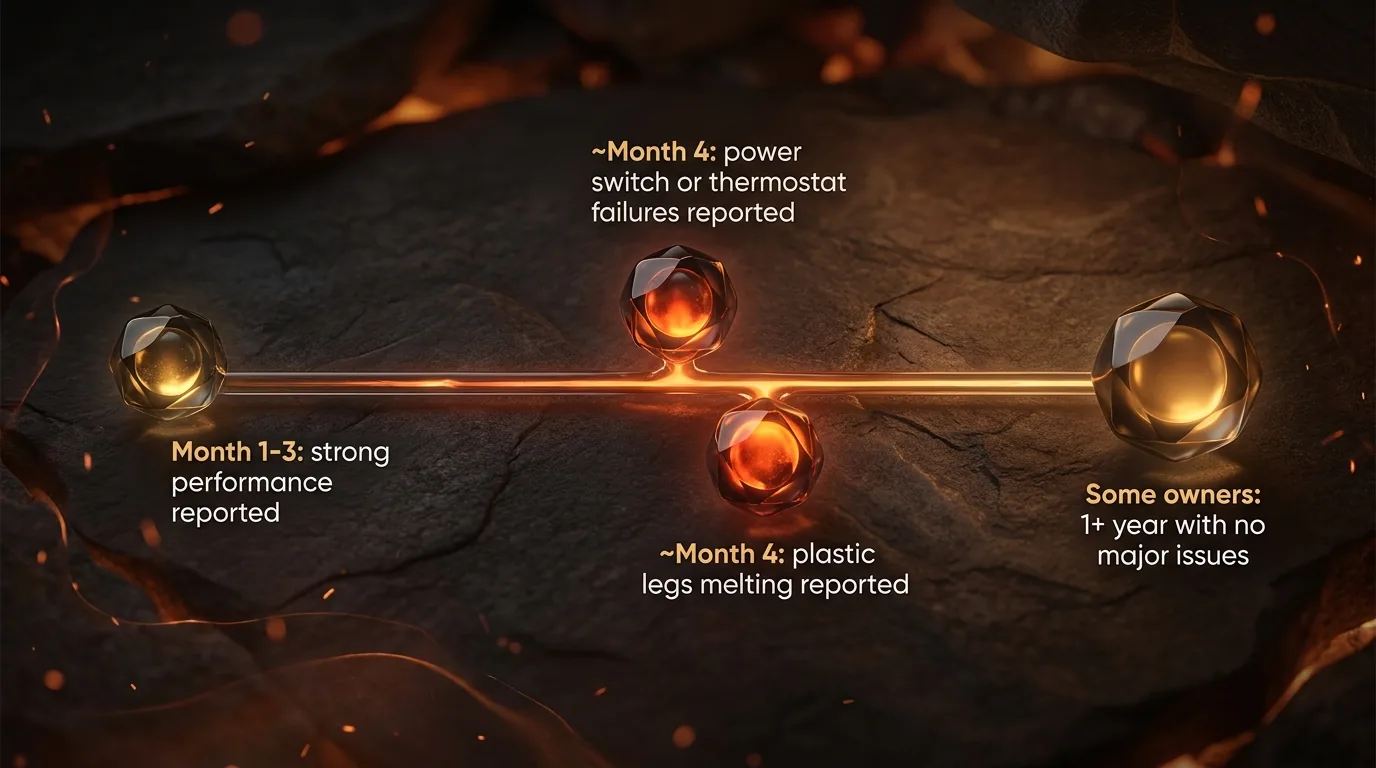
Those two glowing decks and the promise of near-commercial output for $569 - this is where the story catches up with it. A recurring pattern in owner reports centers on roughly the four-month mark of regular use: a power switch melts and keeps melting on replacement, a thermostat fails, cables or the front panel take heat damage, or a heating element - sometimes an entire deck - stops working.
The most specific and well-documented failure is the original plastic legs, which melted and deformed under sustained thermal load from hours of daily commercial use. CROSSON acknowledged the defect and now ships steel replacement legs; confirm you're getting steel, not plastic, on any current order.
How long does it actually last? There's no single answer. Some owners run a year or more of small-scale commercial service without a major failure; others hit the electrical wall right at four months. That spread points to manufacturing consistency, not a fixed lifespan - budget for possible part swaps and treat month four as a checkpoint, not a guarantee of doom.
Customer Service, Shipping Damage, and the Real Cost Over Time
The seller is genuinely responsive - owners consistently report fast replies and free replacement parts, including stones and steel legs. That's real and worth crediting. But a switch that's been replaced four times and melts every time isn't a warranty win; it's a component that isn't rated for the heat it's sitting next to. Document every failure with photos and a timestamp, and watch whether you're on a parts treadmill rather than a one-time fix.
Shipping damage is also a documented pattern - at least one buyer needed three units before receiving an undamaged oven, with cracked stones and dented corners the common damage modes. Inspect every corner and gently shake the unit before plugging it in; any rattle from a loose interior part is worth a same-day photo and seller contact. Buy from a channel with easy returns for exactly this reason.
Run the real math (our pizza oven savings calculator does it for your city) and $569 isn't the whole cost. Amortized over 500 pizzas, the entry price works out to roughly $1.14 per pizza in equipment cost alone; if the oven fails at four months and needs replacing, that climbs closer to $2.28. A $1,500 NSF commercial deck amortized over a conservative 2,000-pizza lifespan lands nearer $0.75 per pizza. The CROSSON only wins that race if it survives - build that risk into your decision rather than ignoring it.
Who Should Buy It - and Who Should Step Up
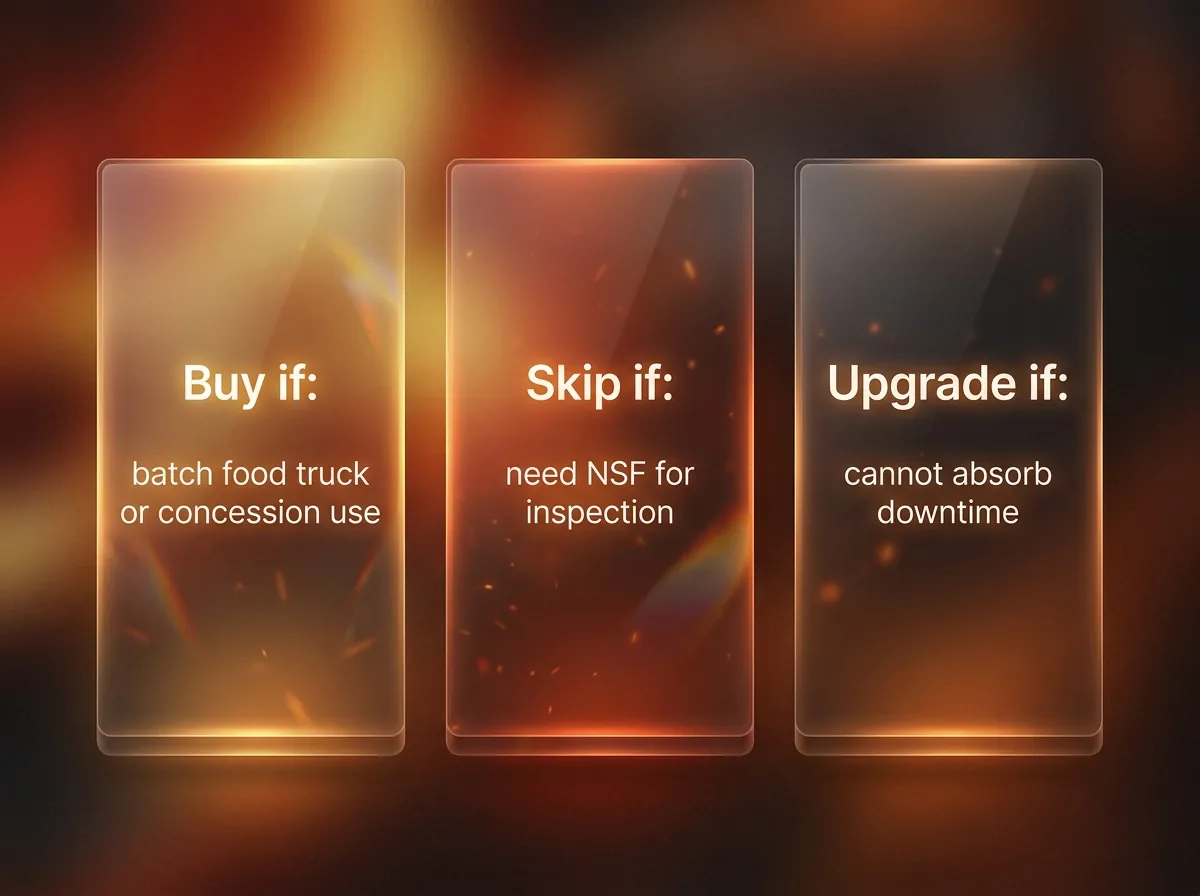
For a food truck, bar kitchen, or concession stand running batch pizza without a health-inspection requirement, the CROSSON earns its price. It's popular in exactly that setting for a reason: real double-deck output, real stone-baked crust, at a fraction of the commercial tier's cost. If you want the wider field before deciding, our buying guide to the best commercial pizza ovens lays out what the step-up tier actually buys you in certification and lifespan.
If you need NSF sign-off for a permitted kitchen, can't absorb weeks of downtime if a switch fails, or you're only cooking one or two pizzas at a time, this isn't your oven - a true NSF commercial double-deck in the $1,500-$3,000+ range, or a simpler single-deck unit for low volume, is the better call. And if electric format flexibility matters more than commercial batch size, our roundup of the best electric pizza ovens covers the home-scale alternatives worth a look.
How it compares
| CROSSON Double Deck 16" Electric Pizza Oven | PYY Double Deck Electric | NSF Commercial Double Deck (Avantco/Omcan class) | |
|---|---|---|---|
| Price | ~$569 | ~$399 | ~$1,500-$3,000+ |
| Decks | 2 independent | 2 independent | 2 independent |
| Max pizza size | 16" per deck | 16" per deck | 16"-18" per deck |
| Max temperature | 660F | 660°F | Varies by model |
| Independent top/bottom controls | Yes, per deck | Yes, per deck | Yes, per deck |
| NSF certified | Disputed - verify | Not confirmed | Yes |
| Documented owner support history | More established | Limited data available | Commercial parts supply chains |
| Reported reliability signal | ~4-month failure cluster reported by some owners | Limited long-term data | Built for sustained commercial lifecycles |
Also worth considering
PYY Double Deck Electric Pizza Oven
The closest structural clone at roughly $170 less. It gets you double-deck capacity at an even lower entry cost, but there's less documented owner-support history to lean on, and the same NSF uncertainty applies. The CROSSON's price premium mostly buys a more established seller-response track record, which matters given the parts-treadmill risk on both.
Ooni Volt 2
A completely different category - a premium home indoor electric built for one or two Neapolitan-style pies with exceptional crust artisanship, not batch throughput. If you're a home cook chasing crust quality for a small household, this beats the CROSSON outright. If you're running a batch pizza service, it's the wrong tool entirely.
Winco Single-Deck Commercial Electric
Half the capacity at less than half the price, and the right call if you're only running four to six pizzas per service instead of ten to twelve. There's no dual-deck workflow advantage and no independent per-deck controls at this price, so it can't compete on batch volume - but for small, low-volume operations it's a sensible, cheaper alternative.
Certifications & safety
- ETL listing disputed on unit
- NSF certification not confirmed
- CE mark found on one unit
Frequently asked questions
How hot does the CROSSON double deck pizza oven get?
Both the top-heat and bottom-heat dials on each deck are rated to 660F; under a full preheat with moderate turnover owners report reaching near that ceiling, though heavy sustained turnover can pull it lower.
Is the CROSSON pizza oven NSF certified for a commercial kitchen?
The listing claims ETL, but I can't confirm NSF - one commercial buyer found only a CE mark on the actual unit, so verify the exact stickers with the seller in writing before buying for a permitted kitchen.
Can the CROSSON cook two 16-inch pizzas at once?
Yes, that's the core design - two fully independent 16-inch decks, each with its own dials and timer, running simultaneously during a batch service.
Does the CROSSON pizza oven need a dedicated outlet?
Yes, it draws high power and owners report tripped breakers when sharing a circuit with a refrigerator, so plan a dedicated grounded outlet before installation.
How long does it take to preheat the CROSSON pizza oven?
Budget about 30 minutes for full stone heat saturation before the first pizza goes in, after which a properly preheated pie bakes in roughly 6 to 8 minutes.
Why do the legs on the CROSSON pizza oven melt?
The original legs were plastic and couldn't handle the sustained thermal load of hours-long commercial use, so I'd confirm you're receiving the steel replacement legs CROSSON now ships.
How long does the CROSSON pizza oven last before it breaks?
It varies widely - some owners run over a year of commercial service without major issues, while others hit electrical failures around the four-month mark, so budget for possible part replacements.
How does the CROSSON compare to a real commercial deck oven like Avantco or Omcan?
The CROSSON matches double-deck stone-baked output for a fraction of the cost during its working life, while the NSF-certified commercial tier costs three to five times more but carries the certification and documented lifespan a permitted kitchen actually needs.
CROSSON Double Deck 16" Electric Pizza Oven
★ 3.5/5 · ~$569
Reader comments
Tried this oven, tool, or recipe? Share how it went — real experiences help other home pizza makers.