
The Ooni Karu 12 Bakes a Real 60-Second Neapolitan Pizza - But Budget 30 Minutes to Get There and $150+ More to Gear Up Properly
How it scores
What I liked
- Reaches genuine wood-fired Neapolitan temperatures and bakes a 12-inch pie in as little as 60 seconds once the stone is truly hot
- Native wood and charcoal fuel gives real fire ritual and flavor that a gas-only oven can't replicate
- Light enough at 26.5 lb, with folding legs, to travel to campsites, tailgates, and cabin weekends
- Stainless steel body and ceramic fiber insulation hold up well over years of regular use
- 5-year direct warranty plus a 60-day buy-back guarantee lowers the risk on a $249 purchase
- Ooni customer service consistently resolves stone and part issues fast
- Ooni's own price is now $249, which is a lot of wood-fired oven for the money
- Clear upgrade path within the same ecosystem if your needs grow - gas burner, Karu 2, Karu 16
What could be better
- Gas burner is not included and costs $99-120 extra, despite the multi-fuel name suggesting otherwise
- Real heat-up on wood runs 20-30 minutes, not the marketed 15, with stone temps typically topping out near 700-750°F rather than the full 950°F peak
- Launch technique has a genuine learning curve; sticking and tearing dough is the most common early frustration
- No cool-touch exterior - the chimney and body run hot enough to burn an inattentive hand
- The 0.6-inch cordierite stone is thinner than some rivals and can crack under thermal shock if handled carelessly
- A documented minority of units arrive with shipping damage or develop drip-tray rust
What You Actually Get - and What You Don't
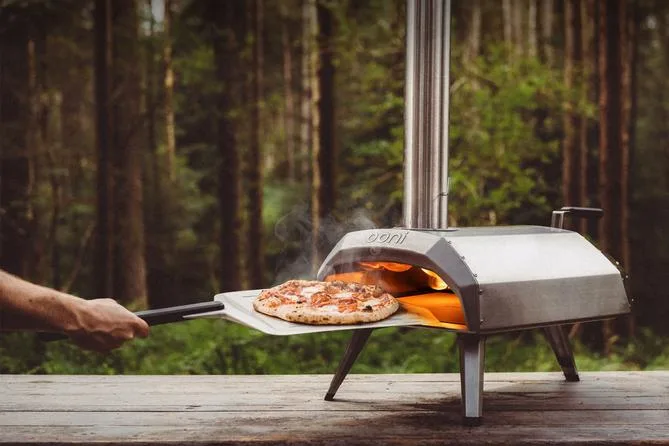
What stands out to me is that the Karu 12 ships as a stainless steel, wood-and-charcoal-fired oven with a 0.6-inch cordierite stone, a removable chimney with an airflow baffle, folding legs, and a fuel basket. That part is straightforward. What trips people up is what's missing: the gas burner. Ooni markets this oven as multi-fuel, and plenty of buyers read that as gas-ready out of the box. It isn't. The gas attachment is a separate purchase, running $99 to $120, and it's consistently the top complaint in owner feedback. You also won't find a peel, an infrared thermometer, or a cover in the box - all three are close to essential, not optional extras, and I'll get to why below.
How Hot It Really Gets - and How Long It Takes

Ooni's number is 950°F (500°C) at peak, with a 12-inch pizza baked in as little as 60 seconds. That's a real ceiling, not a marketing fantasy. But the ready-in-15-minutes line on the box doesn't match what independent testers and owners consistently find on wood: a stone that's genuinely ready to bake, sitting around 700-750°F (370-400°C), usually takes 20 to 30 minutes to get there. Fifteen minutes is achievable in warm weather with dry, split hardwood and a wide-open chimney baffle, but treat that as the best-case scenario, not the rule. The fix isn't patience alone, it's measurement. An infrared thermometer pointed at the center of the stone is the only honest way to know you're ready; a clock will lie to you every time.
Fuel - Wood, Charcoal, or Both, and Where Gas Fits

This is the whole reason the Karu exists instead of the gas-only Koda 12. Native wood and charcoal give you real fire management and real smoke flavor, the tradeoff a gas oven simply can't offer. My preferred setup: build a base layer of lump charcoal for a stable bed of heat, then add a piece of dense hardwood, oak, ash, or a fruitwood, right before you cook for the aromatic smoke on top. Skip softwood like pine; it burns fast, deposits soot, and steals flavor rather than adding it. Keeping the flame alive is mostly about dry fuel and airflow - a damp log or a baffle closed too soon are the two most common reasons a fire dies mid-session.
Gas is the convenience layer here, not the point. It attaches in place of the wood door, so you're picking one fuel path per cook; you can't run gas and wood together. If you find yourself defaulting to gas every single time, the Koda 12 at a similar price is the more honest purchase.
The Launch Curve - Why the First Few Pies Test You, Not the Oven

The single most common complaint I found isn't about heat or fuel - it's dough sticking and tearing on the peel at launch. In a professional kitchen, launch is the first skill you drill, because it's the last thing you can fix once the pizza is airborne. The fix is a five-point routine: use a wooden peel with a generous layer of semolina flour, not fine 00 alone and not a metal peel; shake the peel before you top and again right before you launch - if it doesn't slide freely, stop and add more flour underneath; work fast, under three minutes from stretched dough to launch; start at 10 inches for your first three or four cooks instead of the full 12; and keep toppings light until the motion feels automatic. Most people report the launch clicking into place by the fourth cook. That's not a flaw in the oven, it's a normal skill curve that happens to play out in your backyard instead of a kitchen classroom.
Build Quality and the Stone-Cracking Question
The stainless body and ceramic fiber insulation hold up well; owners with several years of regular use report only cosmetic wear and a stone that still bakes fine. The recurring weak point is the drip tray, which is prone to surface rust, and a minority of units arrive with shipping damage or a bent part. Ooni's customer service has a strong track record of sending replacements quickly.
The 0.6-inch cordierite stone deserves a specific warning. It can crack, and the cause is almost always thermal shock: a cold or damp stone dropped into a hot oven, or water hitting a hot surface during cleaning. Always heat the stone from cold inside the oven, never add water while it's hot, and let it cool fully before you store or move it. Handled that way, cracking is preventable, not inevitable.
The Real Cost of Owning One

The $249 sticker price is only the entry fee. Add a wooden peel ($30-50), a turning peel ($20-40), an infrared thermometer ($20-30), and a cover ($30-50), and you're at $349-419 before buying a single log. Add the gas burner and a propane tank and you're closer to $540-640. That's real money and it belongs in the decision, not a footnote. The upside: amortized over a season of regular use, a Karu-baked pizza lands around $4-5 including fuel and dough, against $15-25 for delivery in most US cities. Cook weekly and the whole setup pays for itself inside a single summer.
Karu 12 vs Karu 2 vs Koda 12 - Which One to Actually Buy

The Karu 2 is the direct successor, and for most buyers paying close to full price it's the smarter choice. It adds a hinged glass door, a built-in thermometer, and a larger fuel basket that testing shows uses roughly 36% less fuel while reaching temperature about 29% faster. That's $50-100 more, but it solves two of the Karu 12's real usability gaps in one upgrade.
The Koda 12 is a different question entirely - it swaps live fire for a gas dial, trading wood-fired flavor for consistency and zero fire management. If flavor and ritual matter to you, the Karu wins; if you just want reliable pizza with minimal attention, the Koda 12 wins. I go through this decision in more depth, including where the Karu 16 and the Gozney Roccbox fit, in our full breakdown of every current Ooni oven. If you're weighing an entirely different brand path, the Bertello vs Ooni breakdown is worth a look before you commit.
Who It's For - and Who Should Skip It
Buy the Karu 12 at Ooni's $249, want the wood-fired flavor and fire ritual the Koda 12 can't give you, and you're willing to treat the first few cooks as tuition. At full price, the Karu 2's added features make more sense for most people. Skip it entirely if you want zero learning curve and zero attention during the cook - go gas with the Koda 12 - or if you're set on a long-haul, premium build and can spend $400-500 on a Roccbox instead.
How it compares
| Ooni Karu 12 | Ooni Karu 2 | Ooni Koda 12 | |
|---|---|---|---|
| Price | $249 | $449 | $399 |
| Fuel | Wood, charcoal, gas add-on | Wood, charcoal, gas-ready | Gas/propane only |
| Door | No glass door | Hinged glass door, magnetic lock | N/A |
| Built-in thermometer | No | Yes | No |
| Heat-up (real-world) | 20-30 min on wood | ~15-20 min (larger basket) | ~15-20 min on gas |
| Weight | 26.5 lb | ~34 lb | ~20 lb |
| Attention required | High, fire management | Moderate, still wood-capable | Low, dial-controlled |
| Warranty | 5-year direct | 5-year direct | 5-year direct |
| Best for | Budget entry, wood flavor | Best all-round 12-inch | Gas convenience |
Also worth considering
Ooni Karu 2
This is the oven the Karu 12 should have been. A hinged glass door removes the guesswork of checking on your pie, the built-in thermometer replaces a tool you'd otherwise need to buy, and the larger fuel basket burns roughly 36% more efficiently and heats about 29% faster. At $50-100 more, it's my default recommendation for anyone not catching the Gen-1 on a deep sale.
Ooni Koda 12
The simplicity pick. No fire management, dial-controlled temperature, and a lighter body around 20 lb. It makes excellent pizza with none of the Karu's ritual. If you own a gas grill already and want a pizza oven that behaves like an appliance, this is it - but it cannot give you wood-fired flavor, full stop.
Gozney Roccbox
The forever oven. At $399-499, it's heavier, better built, easier to hold heat with, and its cool-touch silicone exterior removes the Karu's burn risk entirely. Owners who've used both consistently rate it the better long-term tool, though wood mode requires a separate burner attachment. Buy the Karu 12 to start; buy the Roccbox when you're done learning.
Certifications & safety
- 5-year Ooni direct warranty
- 'Ready in 15 min' claim
- Wood/charcoal needs no US gas listing; Z21.58 applies to the optional gas burner
Answer first
Does the Ooni Karu 12 pay for itself?
until it has paid for itself
$3.82 to make one · $14.69 to order the same size · $10.87 saved
An estimate, not a quote. It assumes US average grocery and fuel prices, a 12" Margherita, four pizzas off one preheat, and the 30-minute preheat we measured (the box says 15). Your grocery bill, your electricity rate and what your local pizzeria charges will all move it.
Adjust every number in the full calculator →Frequently asked questions
Does the Ooni Karu 12 come with the gas burner?
No. The Karu 12 comes with wood and charcoal capability only; the gas burner adapter is sold separately for about $99-120.
How long does the Ooni Karu 12 actually take to heat up?
On wood, expect 20-30 minutes to reach a reliable cooking stone temperature of around 700-750°F, not the marketed 15 minutes.
What's the difference between the Karu 12 and the Karu 2?
The Karu 2 adds a hinged glass door, a built-in thermometer, and a larger fuel basket that uses about 36% less fuel and heats roughly 29% faster, for $50-100 more.
Is the Karu 12 better than the Koda 12?
Neither wins outright - the Karu 12 wins on wood-fired flavor and fuel flexibility, while the Koda 12 wins on convenience and consistent gas-dial control.
Can you use gas and wood in the Karu 12 at the same time?
No. The gas burner attaches in place of the wood and charcoal door, so you pick one fuel path per cook, not both together.
Why do pizzas burn on one side in the Karu 12?
The single flame entry runs the back-right of the stone 50-80°C hotter than the front-left, so turn the pizza every 20-25 seconds to even it out.
Does the Karu 12 pizza stone crack easily?
Not under normal use - cracking is almost always caused by thermal shock, like adding a cold stone to a hot oven or splashing water on a hot surface.
Can you use store-bought pizza dough in the Karu 12?
Yes, but bring it to room temperature for at least 60 minutes first; homemade 00 flour dough cold-fermented 24-48 hours gives noticeably better results.
What's the best wood or fuel for the Ooni Karu 12?
Hardwood is the pick for pizza - it burns hotter and longer than softwood, and owners warn that softwoods like pine burn through fast and need constant feeding. A common, reliable method is to start with a base of lump charcoal for steady heat, then add kiln-dried hardwood chunks (oak, maple, or beech) just before you launch for the flavor and a final temperature push. Avoid resinous softwoods and anything painted, treated, or construction-grade.
Ooni Karu 12 or Gozney Roccbox - which should you buy?
It comes down to how long you plan to keep it. Owners who have both consistently say the Gozney Roccbox holds heat better, feels better built, has a cool-touch silicone exterior (the Karu's metal body and chimney get hot enough to burn a careless hand), and carries a longer warranty - but it costs more and needs a separate attachment to burn wood. The Karu 12 is cheaper (often less on sale), burns wood and charcoal out of the box, and is the better 'learn on it, maybe upgrade later' choice. Buy the Roccbox if you want a premium forever-oven; buy the Karu 12 if you want real wood-fired flavor at the lowest entry price.
Is the Ooni Karu 12 worth it?
For most home cooks who want real wood-fired pizza on a budget, yes. It reaches genuine Neapolitan stone temperatures, cooks a pie in 60-90 seconds once hot, and delivers a live-fire flavor a gas-only oven simply can't - for $249 on Ooni's own site. Just go in with clear expectations: the first few launches will stick until you get the hang of semolina and speed, real heat-up on wood runs about 20-30 minutes (not the marketed 15), and you'll want to budget for a wooden peel plus the roughly $99-120 gas burner if you want the gas option, which is not included.
Ooni Karu 12
★ 4.1/5 · $249
Reader comments
Tried this oven, tool, or recipe? Share how it went - real experiences help other home pizza makers.